|
 |
 |
 |
 |
 |
 |
 |
 |

 |
Global Warming Hits Mars Too
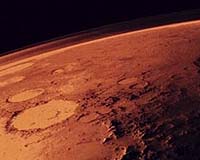
Paris (AFP) Apr 06, 2007 Global warming could be heating Mars four times faster than Earth due to a mutually reinforcing interplay of wind-swept dust and changes in reflected heat from the Sun, according a study released Wednesday. Scientists have long observed a correlation on Mars between its fluctuating temperatures -- which range from -87 C to - 5 C (-125 F to 23 F) depending on the season and the location -- and the darkening or lightening of swathes of the planet's surface. The explanation is in the dirt. Glistening Martian dust lying on the ground reflects the Sun's light -- and its heat -- back into space, a phenomenon called albedo. But when this reddish dust is churned up by violent winds, the storm-ravaged surface loses its reflective qualities and more of the Sun's heat is absorbed into the atmosphere, causing temperatures to rise. The study, published on Thursday by the British journal Nature, shows for the first time that these variations not only result from the storms but help cause them too. It also suggests that short-term climate change is currently occurring on Mars and at a much faster rate than on Earth. Its authors, led by Lori Fenton, a planetary scientist at NASA, describe the phenomenon as a "positive feedback" system -- in other words, a vicious circle, in which changes in albedo strengthen the winds which in turn kicks up more dust, in turn adding to the warming. In the same way, if a snow-covered area on Earth warms and the snow melts, the reflected light decreases and more solar radiation is absorbed, causing local temperatures to increase. If new snow falls, a cooling cycle starts. For Earth, global warming is mainly associated with human activities -- notably the burning of fossil fuels -- that release carbon dioxide (CO2) into the atmosphere, trapping more of the Sun's heat. But changes in our planet's average temperature can also be driven up or down by natural phenomena such as shifts in orbit or axis rotation, and the release of naturally-occurring greenhouse gases by volcanoes and vegetation. On Mars, there have been an unusual number of massive, planet-darkening storms over the last 30 years, and computer models indicate that surface air temperatures on the Red Planet increased by 0.65 C (1.17 F) during from the 1970s to the 1990s. Residual ice on the Martian south pole, they note, has steadily retreated over the last four years. By comparison, the average temperature of Earth increased by 0.75 C (1.33 F) over the last century. To measure the change in patterns of reflected light, Fenton and her colleagues compared thermal spectrometer images of Mars taken by NASA's Viking mission in the late 1970s with similar images gathered more than 20 years later by the Global Surveyor. They then analyzing the correlation between albedo variations, the presence of atmospheric dust and change in temperature. Exactly what triggers the planet's so-called "global dust storms" remains a mystery. But any future research must now consider albedo variations as one of the factors that drive Martian climate change, they conclude. Mars is the fourth planet from the Sun, with a surface area of about 230 million square kilometers (90 million square miles). The Red Planet rotates on its axis every 24.62 hours, and its year lasts 686.93 Earth days. Its atmosphere is composed mostly of carbon dioxide. The albedo of Earth, averaged across all its different surfaces, is about 30 times greater than that of Mars, which is far darker.
Source: Agence France-Presse Community Email This Article Comment On This Article Related Links Mars News and Information at MarsDaily.com Solar Science News at SpaceDaily Mars News and Information at MarsDaily.com Lunar Dreams and more
 MARSIS Radar Estimates The Volume Of Water In The South Pole Of Mars
 Paris, France (SPX) Apr 05, 2007
By studying the South Polar region of Mars, the MARSIS (Mars Advanced Radar for Subsurface and Ionospheric Sounding) radar of the Mars Express space probe has enabled the structure of the layered deposits of this region to be elucidated. For the first time in the history of planetary exploration, topographic maps of the Martian sub-soil have been produced, revealing considerable volumes of ice. |
|
|

| The content herein, unless otherwise known to be public domain, are Copyright 1995-2006 - SpaceDaily.AFP and UPI Wire Stories are copyright Agence France-Presse and United Press International. ESA PortalReports are copyright European Space Agency. All NASA sourced material is public domain. Additionalcopyrights may apply in whole or part to other bona fide parties. Advertising does not imply endorsement,agreement or approval of any opinions, statements or information provided by SpaceDaily on any Web page published or hosted by SpaceDaily. Privacy Statement |