
 |
 |
 |
 |
 |
 |
 |
 |
 |

 |
Glacial dams helped Tibet keep its cutting edge
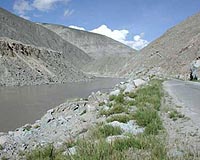
Paris (AFP) Oct 8, 2008 Boulders and soil left by retreating glaciers helped preserve the mighty Tibetan plateau from being worn away by river erosion, scientists said in a study released Wedneday. The plateau resulted from the collision of the Indian and Asian continental plates around 50 million years ago, creating some of the world's greatest rivers and gorges and the most glaciated region outside the north and south poles. In a study published by the British-based science journal Nature, the investigators looked at the Tsangpo River, the world's highest major river, which starts at an elevation of 4,400 metres (13,500 metres) before slicing through the Himalayas and emptying into the Bay of Bengal. The Tsangpo cuts out vast quantities of soil and rock on its way to the sea but in its upper reaches it has had strangely little erosive effect on the edges of the Tibetan plateau. The reason, say the team, is that over millions of years, glaciers advanced and retreated over the region, depositing debris at the mouth of many of the tributaries to the Tsangpo as they came and went. These debris walls, called moraines, are acting as dams, preventing the rushing water in the main Tsangpo gorge from carving upstream into the plateau. "At the edge of the plateau, the river's erosion has been defeated because the dams have flattened the river's slope and reduced its ability to cut into the surrounding terrain," co-author David Montgomery of the University of Washington said in a press release. The findings are more than of academic interest, for they demonstrate that some natural lakes in the southeastern margin of the Tibetan plateau are in effect being held back by moraines. Meltwater discharge from glaciers -- which is expected to accelerate as a result of climate change -- could cause a swift and dangerous buildup behind these natural dams. "Some of these lakes may give rise to catastrophic outburst floods with far-reaching consequences for both the local and downstream population," lead author Oliver Korup, of the Swiss Federal Institute for Snow and Avalanche Research, told AFP. "This has been the case historically," he said. "Quite a number of flooding disasters in Indian rivers have had their cause in the sudden failure of nature dams in Tibetan headwaters. You may imagine that this may generate quite some international friction." Community Email This Article Comment On This Article Share This Article With Planet Earth
Related Links Beyond the Ice Age
 NASA Data Show Arctic Saw Fastest August Sea Ice Retreat on Record
 Greenbelt MD (SPX) Sep 29, 2008
Following a record-breaking season of arctic sea ice decline in 2007, NASA scientists have kept a close watch on the 2008 melt season. Although the melt season did not break the record for ice loss, NASA data are showing that for a four-week period in August 2008, sea ice melted faster during that period than ever before. |
|
|

| The content herein, unless otherwise known to be public domain, are Copyright 1995-2007 - SpaceDaily.AFP and UPI Wire Stories are copyright Agence France-Presse and United Press International. ESA Portal Reports are copyright European Space Agency. All NASA sourced material is public domain. Additional copyrights may apply in whole or part to other bona fide parties. Advertising does not imply endorsement,agreement or approval of any opinions, statements or information provided by SpaceDaily on any Web page published or hosted by SpaceDaily. Privacy Statement |
 del.icio.us
 Digg
Digg Reddit
 YahooMyWeb
 Google
 Facebook