
 |
 |
 |
 |
 |
 |
 |
 |
 |

 |
Giant Simulation Could Solve Mystery Of Dark Matter
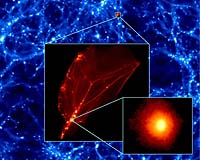
Durham, UK (SPX) Nov 06, 2008 The search for a mysterious substance which makes up most of the Universe could soon be at an end, according to new research. Dark matter is believed to account for 85 per cent of the Universe's mass but has remained invisible to telescopes since scientists inferred its existence from its gravitational effects more than 75 years ago. Now the international Virgo Consortium, a team of scientists including cosmologists at Durham University, has used a massive computer simulation showing the evolution of a galaxy like the Milky Way to "see" gamma-rays given off by dark matter. They say their findings, published in the prestigious scientific journal Nature, could help NASA's Fermi Telescope in its search for the dark matter and open a new chapter in our understanding of the Universe. The Virgo Consortium looked at dark matter halos - structures surrounding galaxies - which contain a trillion times the mass of the Sun. Their simulations - called The Aquarius Project - showed how the galaxy's halo grew through a series of violent collisions and mergers between much smaller clumps of dark matter that emerged from the Big Bang. The researchers found that gamma-rays produced when particles collided in areas of high dark matter density could be most easily detectable in regions of the Milky Way lying close to the Sun in the general direction of the galaxy's centre. They suggest the Fermi Telescope should search in this part of the galaxy where they predict that gamma-rays from dark matter should glow in "a smoothly varying and characteristic pattern". If Fermi does detect the predicted emission from the Milky Way's smooth inner halo the Virgo team believes it might be able to see otherwise invisible clumps of dark matter lying very close to the Sun. The Virgo research involved scientists from the Max Planck Institute for Astrophysics in Germany, The Institute for Computational Cosmology at Durham University, UK, the University of Victoria in Canada, the University of Massachusetts, USA, and the University of Groningen in the Netherlands. Professor Carlos Frenk, Director of the Institute for Computational Cosmology, at Durham University, said: "Solving the dark matter riddle will be one of the greatest scientific achievements of our time. "The search for dark matter has dominated cosmology for many decades. It may soon come to an end." Professor Simon White, Director of the Max Planck Institute for Astrophysics, said: "These calculations finally allow us to 'see' what the dark matter distribution should look like near the Sun where we might stand a chance of detecting it." Dr Volker Springel, of the Max Planck Institute for Astrophysics, led the computer simulations which took 3.5 million processor hours to complete. Dr Springel said: "This calculation has redefined the state of the art in cosmological simulations. At times I thought it would never end." Community Email This Article Comment On This Article Share This Article With Planet Earth
Related Links Durham University Virgo Consortium Stellar Chemistry, The Universe And All Within It
 The Great Cosmic Challenge
 London, UK (SPX) Oct 30, 2008
today cosmologists are challenging the world to solve a compelling statistical problem, to bring us closer to understanding the nature of dark matter and energy which makes up 95 per cent of the 'missing' universe. |
|
|

| The content herein, unless otherwise known to be public domain, are Copyright 1995-2007 - SpaceDaily.AFP and UPI Wire Stories are copyright Agence France-Presse and United Press International. ESA Portal Reports are copyright European Space Agency. All NASA sourced material is public domain. Additional copyrights may apply in whole or part to other bona fide parties. Advertising does not imply endorsement,agreement or approval of any opinions, statements or information provided by SpaceDaily on any Web page published or hosted by SpaceDaily. Privacy Statement |
 del.icio.us
 Digg
Digg Reddit
 YahooMyWeb
 Google
 Facebook