|
 |
 |
 |
 |
 |
 |
 |
 |

 |
Giant Planet Birth Linked To That Of Primitive Meteorites
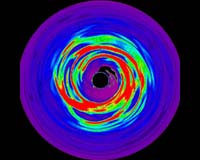
Washington DC (SPX) Mar 04, 2005 Scientists now believe that the formation of Jupiter, the heavy-weight champion of the Solar System's planets, may have spawned some of the tiniest and oldest constituents of our Solar System - millimeter-sized spheres called chondrules, the major component of primitive meteorites. The study, by theorists Dr. Alan Boss of the Carnegie Institution and Prof. Richard H. Durisen of Indiana University, is published in the March 10, 2005, issue of The Astrophysical Journal (Letters). "Understanding what formed the chondrules has been one of biggest problems in the field for over a century," commented Boss. "Scientists realized several years ago that a shock wave was probably responsible for generating the heat that cooked these meteoritic components. But no one could explain convincingly how the shock front was generated in the solar nebula some 4.6 billion years ago. "These latest calculations show how a shock front could have formed as a result of spiral arms roiling the solar nebula at Jupiter's orbit. "The shock front extended into the inner solar nebula, where the compressed gas and radiation heated the dust particles as they struck the shock front at 20,000 mph, thereby creating chondrules," he explained. "This calculation has probably removed the last obstacle to acceptance of how chondrules were melted," remarked theorist Dr. Steven Desch of Arizona State University, who showed several years ago that shock waves could do the job. "Meteoriticists have recognized that the ways chondrules are melted by shocks are consistent with everything we know about chondrules. But without a proven source of shocks, they have remained mostly unconvinced about how chondrules were melted.The work of Boss and Durisen demonstrates that our early solar nebula experienced the right types of shocks, at the right times, and at the right places in the nebula to melt chondrules. "I think for many meteoriticists, this closes the deal. With nebular shocks identified as the culprit, we can finally begin to understand what the chondrules are telling us about the earliest stages of our Solar System's evolution," he concluded. "Our calculation shows how the 3-dimensional gravitational forces associated with spiral arms in a gravitationally unstable disk at Jupiter's distance from the Sun (5 times the Earth-Sun distance), would produce a shock wave in the inner solar system (2.5 times the Earth-Sun distance, i.e., in the asteroid belt)," Boss continued. "It would have heated dust aggregates to the temperature required to melt them and form tiny droplets." Durisen and his research group at Indiana have independently made calculations of gravitationally unstable disks that also support this picture. While Boss is well known as a proponent of the rapid formation of gas giant planets by the disk instability process, the same argument for chondrule formation works for the slower process of core accretion. In order to make Jupiter in either process, the solar nebula had to have been at least marginally gravitationally unstable, so that it would have developed spiral arms early on and resembled a spiral galaxy. Once Jupiter formed by either mechanism, it would have continued to drive shock fronts at asteroidal distances, at least so long as the solar nebula was still around. In both cases, chondrules would have been formed at the very earliest times, and continued to form for a few million years, until the solar nebula disappeared. Late-forming chondrules are thus the last grin of the Cheshire Cat that formed our planetary system. Boss's research is supported in part by the NASA Planetary Geology and Geophysics Program and the NASA Origins of Solar Systems Program. The calculations were performed on the Carnegie Alpha Cluster, the purchase of which was supported in part by the NSF Major Research Instrumentation Program. Durisen's research was also supported in part by the NASA Origins of Solar Systems Program. Community Email This Article Comment On This Article Related Links SpaceDaily Search SpaceDaily Subscribe To SpaceDaily Express Asteroid and Comet Mission News, Science and Technology
 NASA'S Spitzer Finds Possible Comet Dust Around Dead Star
 Pasadena CA (SPX) Jan 12, 2006
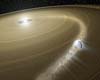
NASA's Spitzer Space Telescope has spotted what may be comet dust sprinkled around the white dwarf star G29-38, which died approximately 500 million years ago. |
|
|

| The content herein, unless otherwise known to be public domain, are Copyright 1995-2006 - SpaceDaily.AFP and UPI Wire Stories are copyright Agence France-Presse and United Press International. ESA PortalReports are copyright European Space Agency. All NASA sourced material is public domain. Additionalcopyrights may apply in whole or part to other bona fide parties. Advertising does not imply endorsement,agreement or approval of any opinions, statements or information provided by SpaceDaily on any Web page published or hosted by SpaceDaily. Privacy Statement |