|
 |
 |
 |
 |
 |
 |
 |
 |

 |
Giant "Eyeball" Brings Mega Scope Closer
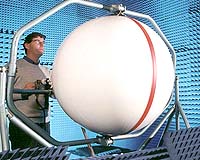
Sydney - July 3, 2001 A satellite receiver that works like a giant eyeball has arrived in Sydney for testing by CSIRO. Its arrival brings a step closer one idea for the world's next 'mega-telescope' �an army of giant spheres to collect radio waves from the cosmos, dotted in patches across the landscape. Testing the 'eyeball' will help CSIRO refine the mathematics and software for designing its own spherical collectors for the mega-telescope. The 1-m white sphere has the same function as a satellite dish �collecting and concentrating radio waves. It's a lens that focuses radio waves to a point, just as the lens in your eyeball focuses light to a point on your retina. And like your eye, but unlike today's radio telescopes or communications antennas, the lens can 'see' many radio sources in the sky at once. This 'Luneburg lens' is a commercial one built in Russia: they are not readily available in western countries. But CSIRO engineers realised they offered unique advantages for the technically challenging mega-telescope. Australia is one of the most active of the 11 countries now planning this telescope, called the Square Kilometre Array or SKA. Construction will start around 2010. The telescope's prime goal is to look far back enough into the early Universe to see the first galaxies forming. It will be a hundred times bigger than even today's biggest telescopes, all the better to capture the weak whispers from the early Universe. Its total collecting area � one square kilometre or one million square metres � will not be a single huge surface. Instead it will be many small surfaces, grouped in patches. Several concepts for the telescope have been put forward. They range from large collectors set into the ground to a swarm of satellite dishes. Australia's visions are the most radical and include Luneburg lenses or a 'phased array' of small flat collectors. "The SKA would need tens of thousands of Luneburg lenses, each about five metres in diameter," says Dr Peter Hall, CSIRO SKA Program Leader. "We need to find cheap and easy ways to mass-produce them." The Russian lens is made of high-density polystyrene. CSIRO is developing lighter, cheaper materials that absorb less of the precious radio signal. "These materials can be applied in many other areas of radio and antenna engineering," said Dr Andrew Parfitt of CSIRO Telecommunications and Industrial Physics. CSIRO is a member of the Australian SKA consortium, which is coordinating Australia's participation in the project. "We aim to build a 'demonstrator system' of lenses or flat collectors to show that the ideas will work," says Dr Hall. "They'd be built alongside CSIRO's existing Australia Telescope at Narrabri and integrated with it." This would both test the viability of the technology and make the Australia Telescope uniquely able to see many different parts of the sky at once. "If we get the funding to do this we'll be letting contracts to Australian industries to build the collecting elements," Dr Hall says. Australia will unveil these plans at a major international meeting on the SKA that starts on 9 July at the University of California Berkeley. As well as undertaking technical work, Australia has also begun to test possible SKA sites � the first country to do so. "The site has to meet various technical requirements. One of the most important is being in an area relatively free of man-made radio signals, which can swamp the extremely weak cosmic signals," Dr Hall explains. "In this respect, Australia has the edge over many other countries," he says. Some initial site testing has been done in Western Australia. Other areas of Australia will be looked at too. "The SKA site will be chosen by the international astronomy community in 2005," Dr Hall says. "They know that Australia would be a good host country � it has an interference-free environment, is politically stable, it's technologically sophisticated and the climate is suitable." "But we still need to do a lot of groundwork before we put in a bid to host." An economic analysis has shown that the benefits of hosting the billion-dollar telescope would amply repay Australia's investment in it, he said. The countries currently participating in the international SKA consortium are Australia, Canada, China, Germany, India, Italy, Poland, The Netherlands, Sweden, the U.K. and the U.S.A. Community Email This Article Comment On This Article Related Links SpaceDaily Search SpaceDaily Subscribe To SpaceDaily Express The latest information about the Commercial Satellite Industry
 Squeezing Ukraine In Space
 Moscow (UPI) Dec 18, 2005
Despite political differences, Russia and Ukraine used to play on the same "space" field in pre-"Orange Revolution" times. Today the situation is radically altered and the Ukrainian space industry risks stagnating and losing its positions as the space component of the national economy. |
|
|

|
|
|
|
|
|
|
|
|
|
|
|
| The content herein, unless otherwise known to be public domain, are Copyright 1995-2006 - SpaceDaily.AFP and UPI Wire Stories are copyright Agence France-Presse and United Press International. ESA PortalReports are copyright European Space Agency. All NASA sourced material is public domain. Additionalcopyrights may apply in whole or part to other bona fide parties. Advertising does not imply endorsement,agreement or approval of any opinions, statements or information provided by SpaceDaily on any Web page published or hosted by SpaceDaily. Privacy Statement |