|
 |
 |
 |
 |
 |
 |
 |
 |

 |
Getting To Dawn
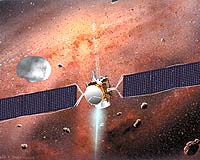
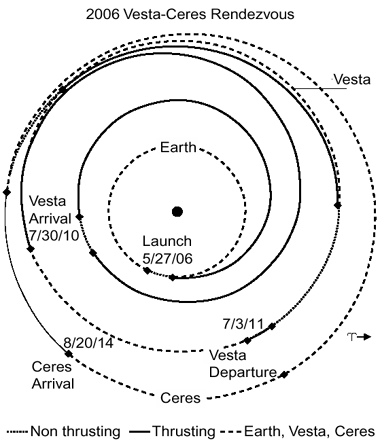
Pasadena - Mar 19, 2003 The design of Dawn's trajectory is difficult, unusual, and interesting because of the use of solar electric propulsion, implemented on Dawn as an ion propulsion system (IPS). While providing performance far in excess of what conventional chemical propulsion would deliver, the IPS necessitates the use of design tools and methods quite different from what has been used for the development of trajectories since the dawn of the solar system (or, at least, since the dawn of space exploration). Rather than finding a few points at which impulsive maneuvers are required, this problem involves the determination of IPS thrust vectors over years of continuous thrusting. Unlike trajectories for ballistic missions, Dawn's depends sensitively on the spacecraft's power system (because power translates directly into IPS thrust). The tools that generate the trajectories require much more coaxing and cajoling (and sometimes pleading) than the tools that have been used for conventional missions.
Therefore, a substantial effort is devoted to designing a trajectory with enough "mission margin" that most spacecraft problems that interfere with IPS thrusting do not jeopardize reaching both Vesta and Ceres. (Missions relying on chemical propulsion tend to have greater vulnerability for shorter times.) The initial work is focused on obtaining an understanding of the sensitivity of the trajectory to parameters that we can control. Ultimately we will develop a baseline trajectory that accounts for constraints such as the finite launch period, launch window, Vesta arrival window (to ensure good lighting for framing camera and mapping spectrometer observations of the south pole), Ceres arrival window (for lighting at one of the poles), mission margin, periods in which spacecraft activities preclude thrusting in the optimal direction, spacecraft power characteristics, flybys of other asteroids during the interplanetary cruise, and others. We separately analyze the orbit insertion, departure, and orbit transfers at each primary science target, where the complexity of spiraling around the bodies requires different analytical techniques. Steve Williams and Dr. Greg Whiffen of JPL are the principal trajectory analysts on Dawn. Steve designed the trajectory for Deep Space 1 (DS1), the mission that tested the IPS design Dawn uses. Many issues that an operational IPS flight would face were revealed during that work; prior analyses had rarely, if ever, exceeded the depth necessary for conceptual studies. Greg has written a powerful new trajectory design tool that complements the one used for DS1. With his new software, Greg has generated our first looks at the Vesta orbit transfers. The first baseline trajectory will be completed by early April. Although preliminary, it will be significantly more accurate than previous calculations. Community Email This Article Comment On This Article Related Links Dawn Presentation: Asteroids, Comets and Meteors 2002 - PDF File Dawn at UCLA An Overview of Dawn SpaceDaily Search SpaceDaily Subscribe To SpaceDaily Express Asteroid and Comet Mission News, Science and Technology
 NASA'S Spitzer Finds Possible Comet Dust Around Dead Star
 Pasadena CA (SPX) Jan 12, 2006
NASA's Spitzer Space Telescope has spotted what may be comet dust sprinkled around the white dwarf star G29-38, which died approximately 500 million years ago. |
|
|

| The content herein, unless otherwise known to be public domain, are Copyright 1995-2006 - SpaceDaily.AFP and UPI Wire Stories are copyright Agence France-Presse and United Press International. ESA PortalReports are copyright European Space Agency. All NASA sourced material is public domain. Additionalcopyrights may apply in whole or part to other bona fide parties. Advertising does not imply endorsement,agreement or approval of any opinions, statements or information provided by SpaceDaily on any Web page published or hosted by SpaceDaily. Privacy Statement |