|
 |
 |
 |
 |
 |
 |
 |
 |

 |
Getting A Run For Your Money In Space
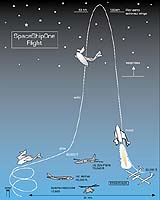
Cape Canaveral FL (UPI) Jul 27, 2004 Scaled Composites of Mojave, Calif., hardly seems the company to jump into the role of Goliath. True, the firm has been around for a while -- 22 years and counting -- and it does have one of its inventions hanging in the National Air and Space Museum: an airplane called Voyoger that traveled around the world non-stop and without refueling in 1986. Also, Scaled Composites did last month earn the distinction of becoming the first private firm to send a piloted craft into space. Still, Scaled Composites is a lean organization, producing exotic, one-of-a-kind aircraft and other vehicles that are made of non-metal, composite materials. It is only in comparison to a true shoe-string organization, such as the da Vinci Project in Toronto, Ontario, that Scaled Composites looms large as a Titan. With roughly five months remaining before the $10 million Ansari X Prize expires, the race to send a three-person craft into sub-orbital space comes down to a modern day showdown of David and Goliath. At least, that is the stage the audience is expecting when Burt Rutan, founder of Scaled Composites, and Brian Feeney, leader of the all-volunteer da Vinci Project, gather at the Santa Monica Municipal Airport in California on Tuesday with X Prize co-founder Peter Diamandis for an announcement. According to the contest rules, contenders must give at least a 60-day notice that they intend to make a run for the money. The cash and a large trophy are to be awarded to the first team that makes it into space twice within two weeks. Both teams are expected to launch single pilots, with ballast of 396 pounds -- the weight set by X Prize rules -- to sit in for the other two passengers. After that, the teams part company. To begin, Scaled Composites' SpaceShipOne will be flown by an experienced test pilot, possibly the same person who was in the cockpit during the ship's initial foray out of the atmosphere during a test run in June: 64-year-old Mike Melvill. The da Vinci Project will fly a man who has never been higher than the altitude of a commercial jet plane, someone who does not even have a pilot's license -- though he has spent months practicing in fighter pilot simulators and astronaut centrifuge trainers. Feeney, 45, plans to climb into his vehicle's crew capsule himself. Neither man considers his actions foolhardy. Melvill, who also serves as Scaled Composites' general manager, has been with the firm since 1978. Rutan hired him on the spot after seeing the home-built aircraft Melvill built from a kit Rutan had sold him. Melvill, who has accumulated more than 6,900 hours of flight time in 123 fixed-wing craft and 11 rotary-wing designs, was the first pilot for nine of Rutan's winged creations, including SpaceShipOne. His experience paid off June 21 when, upon reaching the apex of the highest jump ever made by a private pilot, the flight control system failed, momentarily creating the very real possibility that Melvill would become not only the he first private pilot to reach space, but also the first to die while doing so. Melvill later said the vehicle's trim surfaces -- movable flaps on the craft's wings -- stuck during the supersonic flight and remained uselessly pasted against the craft's body. Melvill reconfigured the trim surfaces manually and left them untouched for landing. The glitch nearly caused him to fall short of the 62-mile (100-kilometer) altitude goal, the official designation of space. This was not a perfect flight, Melvill told reporters afterward. The backup (system) saved the day. Feeney, too, has a backup plan: a bailout system. There is not much else to do aboard a ballistic missile-derived vehicle like the Wild Fire rocket Feeney expects to ride out of the atmosphere. The rocket will be ignited after an 80,0000-foot tow by a helium balloon. Any spaceflight is risky, Feeney noted, but added there is a difference between being reckless and having something go wrong and having a serious level of effort and having something go wrong. I really come from the school that says there's not a person on this planet that will be with us 104 years from now, Feeney told United Press International. We're all limited in the amount of time we spend here. Life is so precious to me that I could not get through life and not try to experience these things and stretch the frontier. He added: It doesn't matter to me at all that if - whether it's myself, preferably no one, but that if -- something does go wrong in the expansion of this new business and this new frontier, as long as we've been as careful as possible and have not been reckless and have done things in the best possible way, there's absolutely no shame in simply not making it to 80 or 90 years old. Life is so precious to me that I couldn't live to 80 or 90 and look back on this and say 'Well, I didn't have guts to try.' That to me would be a failure of life. I couldn't live with myself. That would be a waste of my life. Feeney acknowledged that not everyone thinks this way. I subscribe to the idea that quite often, too many of us on this planet hold on to life way too closely, he said. That doesn't mean you become reckless with it. He said he has been asked by children many times, Mr. Feeney, what happens if you die in space? His answer: There is so much hanging on to life closely, hanging on to 'my piece of real estate, my country, my religion, my ideology' -- and look what we have: We have a fraction-planet, where in various parts of the globe you've got strife and insurrection and such harm that we do to each other, where we take life away from each other for the most careless and thoughtless reasons possible. If this is going to result in some fatalities along the way, it's for all the best reasons of pioneership. Part of the problem, Feeney said, is due to the expansion of global communications and coverage. We've lost over the last few decades that ability to take a risk. We think that life owes us an eternity of living and it doesn't. We're here at the behest of the universe that is 13 billion years behind us. God knows what is in the future for us, but for me life is way too precious not to do something like this. All rights reserved. Copyright 2004 by United Press International. Sections of the information displayed on this page (dispatches, photographs, logos) are protected by intellectual property rights owned by United Press International. As a consequence, you may not copy, reproduce, modify, transmit, publish, display or in any way commercially exploit any of the content of this section without the prior written consent of by United Press International. Community Email This Article Comment On This Article Related Links X Prize Scaled Composites SpaceDaily Search SpaceDaily Subscribe To SpaceDaily Express Space Tourism, Space Transport and Space Exploration News
 X Prize Foundation Announces Teams Ready To Compete For $10 Million
 Los Angeles CA (SPX) Jul 27, 2004
The X Prize Foundation said Tuesday that SpaceShipOne team has given its official 60-day notice unde the competition rules to schedule its first X Prize flight on September 29th, 2004, at the Mojave Airport Civilian Aerospace Test Center in Mojave, California. To win the $10 million, SpaceShipOne will need to make a second flight within two weeks, by October 13th, 2004. |
|
|

| The content herein, unless otherwise known to be public domain, are Copyright 1995-2006 - SpaceDaily.AFP and UPI Wire Stories are copyright Agence France-Presse and United Press International. ESA PortalReports are copyright European Space Agency. All NASA sourced material is public domain. Additionalcopyrights may apply in whole or part to other bona fide parties. Advertising does not imply endorsement,agreement or approval of any opinions, statements or information provided by SpaceDaily on any Web page published or hosted by SpaceDaily. Privacy Statement |