|
 |
 |
 |
 |
 |
 |
 |
 |

 |
Get Ready for the Largest Demolition Derby on the Planet
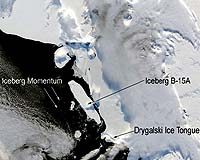
Greenbelt MD (SPX) Dec 24, 2004 What happens when the largest free floating thing on the planet crashes? We might find out in a couple of days. NASA satellites have witnessed a 100-mile-long iceberg near McMurdo Research station move like a battering ram toward Drygalski Ice Tongue. "It's a clash of the titans, a radical and uncommon event," says Robert Bindshadler, a researcher at NASA's Goddard Space Flight Center, and if the two giant slabs of ice collide, we could see one of the best demolition derbies on the planet. When the iceberg and the ice tongue collide, the impact will likely "dent their bumpers," says Bindshadler. The edges could crumple and ice could pile or drift into the Ross Sea. But if the B-15A iceberg picks up enough speed before the two collide, the results could be more spectacular. The Drygalski Ice Tongue could break off. The ice tongue is thick ice that grows out over the Ross Sea from a land-based glacier on Antarctica's Scott Coast. "Ice tongues do break off on occasion," says Bindshadler. "It would only take one thin area on the ice tongue to make it break off." There's no guarantee that the Drygalski Ice Tongue will break off, but "this is the toughest blow it has ever had to deal with." "That Ice tongue has no reason for staying intact" says Waleed Abdalati, researcher with NASA's Goddard Space Flight Center, but Bindshadler points out, it may not break up either. The results depend on the movement of the B-15A iceberg. The B-15A iceberg is a 3,000-square-kilometer (1,200-square-mile) behemoth that has a history of causing problems. It is the largest fragment of a much larger iceberg that broke away from the Ross Ice Shelf in March 2000. Scientists believe that the enormous piece of ice broke away as part of a long-term natural cycle (every 50-to-100 years, or so) in which the shelf, which is roughly the size of Texas, sheds pieces much as human fingernails grow and break off. The berg initially drifted toward McMurdo Sound and grounded near Cape Crozier on Ross Island. It has since broken into pieces, the largest of which is B-15A. This year, B-15A has trapped sea ice in McMurdo Sound. The currents that normally break the ice into pieces and sweep it out into the Ross Sea have not been able to clean out the Sound, so winter's thick ice remains intact. The build-up of ice presents significant problems for Antarctic residents. Penguins must now swim great distances to reach open waters and food. Adult penguins may not be able to make the trip and return with food for their young. As a result, many chicks could starve, says Antarctica New Zealand, the government organization that oversees New Zealand's Antarctic research, in the Associated Press. The National Science Foundation (NSF) officials said that the B-15A iceberg and the frozen Sound will not interfere with supply ship access to McMurdo Station, the U. S. logistics hub for much of the nation's research activity in Antarctica. The U.S. Coast Guard icebreaker Polar Star left Seattle, Washington, on Nov. 4 and should reach the edge of the sea ice around Dec. 27. It will begin immediately to cut a channel in the sea ice for the supply ships. Ironically, a collision between the iceberg and the ice tongue could make things easier for both penguins and ships. If the ice tongue collapses, the way may be opened for sea ice to escape the Sound. There is no guarantee that satellite will see a great demolition because the berg's fate is unclear. The berg's future depends on unpredictable winds, tides and other forces, but possibilities include colliding with the floating Drygalski Ice Tongue, or continuing north, eventually melting. If the collision happens, the impact could come as soon as Dec. 24. If the collision occurs as predicted, this could be an event that we witness again and again. The tides that drive the iceberg's motion tend to push it in circles. "If B-15A bangs the ice tongue once, it could bang it again," says Bindshadler. With multiple daily views of the Ross Sea, NASA satellites will be there to watch the show. Community Email This Article Comment On This Article Related Links SpaceDaily Search SpaceDaily Subscribe To SpaceDaily Express Nuclear Space Technology at Space-Travel.com
 Rewriting Glacial History In Pacific North America
 Edmonton AB (SPX) Jan 10, 2006
Although the story on glacier fluctuations in northwestern North America over the last 10,000 years has remained largely unchanged for decades, new evidence discovered by a University of Alberta researcher will rewrite that glacial history and offer clues about our climate history during the last several thousand years. |
|
|

| The content herein, unless otherwise known to be public domain, are Copyright 1995-2006 - SpaceDaily.AFP and UPI Wire Stories are copyright Agence France-Presse and United Press International. ESA PortalReports are copyright European Space Agency. All NASA sourced material is public domain. Additionalcopyrights may apply in whole or part to other bona fide parties. Advertising does not imply endorsement,agreement or approval of any opinions, statements or information provided by SpaceDaily on any Web page published or hosted by SpaceDaily. Privacy Statement |