Energy News  
Germany to start storing carbon dioxide underground

by Staff Writers
Berlin (AFP) June 30, 2008
Germany was due to inaugurate Europe's first underground carbon dioxide storage site on Monday, the country's national geoscience institute said.

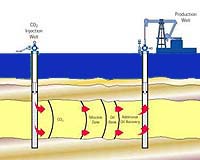
The site at Ketzin, outside Berlin, is part of a European project dubbed CO2SINK which aims to test whether capturing and storing carbon dioxide in subterranean rock is a viable way of fighting global warming, the GFZ centre in Potsdam said.

It will pump up 60,000 tonnes of the greenhouse gas into porous, salt water-filled rock at depths of more than 600 metres (656 yards) over the next two years, the centre said.

The first injection of gas below the surface was due to take place later on Monday.

Reinhard Huettl, the science director of the institute, said storing carbon dioxide underground could slow down global warming and thereby buy scientists extra time to develop alternative energy sources.

"The storage of the greenhouse gas carbon dioxide is an option to win time in the development and introduction of carbon dioxide-reduced energy technology," he said.

Huettl said the site will become a "unique worldwide laboratory" to study the success of the world's main global warming gas.

Some environmental groups have expressed reservations about capturing carbon emissions produced by industry to store it below ground, with Greenpeace saying it posed the risk of highly toxic leaks.

Community
Email This Article
Comment On This Article

Share This Article With Planet Earth
del.icio.usdel.icio.us DiggDigg RedditReddit
YahooMyWebYahooMyWeb GoogleGoogle FacebookFacebook


Related Links


Memory Foam Mattress Review
Newsletters :: SpaceDaily :: SpaceWar :: TerraDaily :: Energy Daily
XML Feeds :: Space News :: Earth News :: War News :: Solar Energy News


Major Technological Progress Needed For 25 Percent Renewable Energy Use To Be Affordable

Washington DC (SPX) Jun 30, 2008
Dramatic progress in renewable energy technology is needed if the United States desires to produce 25 percent of its electricity and motor vehicle fuel from renewable sources by 2025 without significantly increasing consumer costs, according to a RAND Corporation study.


  • US 'won't allow' Iran to shut key Gulf oil route
  • Oxygen Ions For Fuel Cells Get Loose At Lower Temperatures
  • Analysis: KRG explains oil deal breakdown
  • A Novel X-Ray Source Could Be Brightest In The World

  • Toxic legacy: Scientists ponder task of labelling nuclear waste
  • Fluor To Help With Plateau Remediation At DOE's Hanford Site
  • Britain signs nuclear deal with energy-parched Jordan
  • Canada, Jordan sign nuclear co-operation deal

  • Air Travelers And Astronomers Could Benefit From Atmospheric Turbulence Research
  • NASA And Air Resources Board To Examine California Air Quality
  • Field Project Seeks Clues To Climate Change In Remote Atmospheric Region
  • US And UK Research Centers Launch Major Collaboration On Atmospheric Studies

  • Highway plan in Indonesia's Papua threatens forests: NGOs
  • Researchers Explain Nitrogen Paradox In Forests
  • Indonesia's haze plan praised by region
  • Tropical Forest Sustainability Could Be A Climate Change Boon

  • Kazakhstan To Introduce State Monopoly On Caviar Sales
  • UN to press G8 on food crisis, climate change, poverty
  • Japanese fishermen to go on strike over fuel costs
  • Exploited Fish Make Rapid Comeback In World's Largest No-Take Marine Reserve Network

  • Mazda sees hydrogen cars available on large scale by 2020 at best
  • Germany launches programme to develop hybrid vehicles
  • WTF... abbreviation on car plates makes Americans blush
  • Soaring steel costs to drive up car prices: Nissan CEO

  • China's new turboprop rolls off production line: official media
  • European airlines angered by EU 'CO2 tax'
  • China to roll out new turboprop plane: report
  • IATA head slams EU plans to include aviation in emissions trading

  • Nuclear Power In Space - Part 2
  • Outside View: Nuclear future in space
  • Nuclear Power In Space

  • The content herein, unless otherwise known to be public domain, are Copyright 1995-2007 - SpaceDaily.AFP and UPI Wire Stories are copyright Agence France-Presse and United Press International. ESA Portal Reports are copyright European Space Agency. All NASA sourced material is public domain. Additional copyrights may apply in whole or part to other bona fide parties. Advertising does not imply endorsement,agreement or approval of any opinions, statements or information provided by SpaceDaily on any Web page published or hosted by SpaceDaily. Privacy Statement