|
 |
 |
 |
 |
 |
 |
 |
 |

 |
Germany May Send Mideast Troops
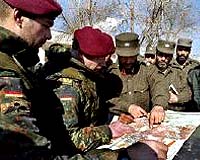
UPI Germany Correspondent Berlin (UPI) Aug 16, 2006 Germany's government leaders Monday signaled they may be ready to dispatch German soldiers to aid the United Nations peacekeeping force along Lebanon's border with Israel. But critics counter the army, already overstretched by campaigns abroad, should not be in a position where it may have to engage Israeli forces. Chancellor Angela Merkel, Vice Chancellor Franz Muentefering, Foreign Minister Frank-Walter Steinmeier and Defense Minister Franz Josef Jung had agreed upon such a move in talks Monday, newspapers reported. Jung will propose the contribution to the United Nations in New York Thursday, and the Bundestag, the lower house of German parliament, will then have to sign off on the mission. Aside from Germany, France, Italy, Belgium, Portugal, and Poland, Malaysia and Indonesia, two Muslim-dominated nations, will contribute troops. Leading German Jews, among them publisher and journalist Michael Friedmann, had spoken against a German contribution to UNIFIL. "I don't want to see armed German soldiers facing Israelis," Friedmann said on a TV show, alluding to the Holocaust in which some six million Jews were systematically killed during Nazi-era Germany. The opposition has steered a similar course. "We believe that for historic reasons, German soldiers should not be put into a position where they may have to shoot at Israeli soldiers," Dirk Niebel, secretary-general of the opposition Free Democrats, told German news channel n-tv. "Also, a U.N. peacekeeping force must be neutral, and it has always been German statesmanship to be on the side of the Israelis." Even inside the government, opposition to such a mission grows: Several politicians of the Christian Social Union, the sister party of Merkel's Christian Democratic Union, have called on the chancellor to keep troops out of Lebanon. Some say the German Bundeswehr, a well-trained, but only moderately funded army, is overstretched with several international missions: Nearly 8,000 German soldiers are scattered on missions around the globe. The Bundeswehr has 2,800 soldiers in Afghanistan, where they make up the largest contingent of any nation in the U.N.-mandated International Security Assistance Force. They are active in Kosovo (2,900 soldiers) and in the Democratic Republic of Congo (780 soldiers), where a European Union mission helps the United Nations safeguard the country's first democratic elections in more than four decades. Wilfried Stolze, spokesman of the Bundeswehrverband, a soldier interest group, told United Press International that because of its many strenuous missions, the Bundeswehr won't go into Lebanon with a big hurrah. "But we have a special responsibility in the region," he said, "and our soldiers should be convinced of this assignment." He admitted, however, that the mission was extremely delicate. "Our soldiers have never been there," he told UPI. "This mission has to be handled with extreme care." He added that the soldiers going into Lebanon would likely receive special training. Israel has welcomed a German contribution to UNIFIL, and observers say the bilateral ties between both countries may strengthen after a successful mission. But a few questions are still on the table: Will Germany send only troops to rebuild the infrastructure, or maybe add a Marine frigate that would patrol off the Lebanese coast? In that case, some 1,000 soldiers would be dispatched, and a worst-case scenario -- combat with Israelis -- could largely be ruled out. Many reports, however, claim the Germans would send a brigade (3,000 soldiers), including combat troops such as infantry and paratrooper units. So what if the worst-case scenario happens, and a German will have to shoot at an Israeli soldier? "Then we mustn't second-guess our contribution," Stolze said. For Germany, such an incident would likely be a media disaster, yet some military analysts welcome the mission because it could mean Germany's final military emancipation of its shameful past, a process that got a first push in 1998, when Berlin sent troops to aid a NATO-mission in the Kosovo, the first combat mission in a foreign country since the end of World War II. Martin Beck, an expert on the region at the Hamburg-based German Institute for Middle East Studies, told UPI that Germany's historic responsibility pushes to the background a debate on how Berlin could play a more constructive role in the Middle East conflict. Beck sees several shortcomings in the U.N. Security Council Resolution 1701, which he says falls short of providing a long-lasting outlook for peace in the region. He also criticized the German government for its recent policy pertaining to the Middle East. "Germany has neglected the original European political interests, which include to end the Israeli occupation of the Palestinian territories," Beck said. "It seems that the policy in the Middle East is mainly used as a vehicle to strengthen the friendship with the United States." When Israel launched its military campaign, the world's most powerful leaders gathered for the Group of Eight Summit in St. Petersburg, Russia. During the early days of the conflict, Merkel -- along with British Prime Minister Tony Blair -- was one of the few European politicians not to call for an immediate cease-fire. Instead, she reiterated Bush's position, saying "we should not forget who started this," meaning Hezbollah and Hamas. Germany sports good contacts with several Arab nations; in the past decades, German negotiators used their ties to Syria and Hezbollah to facilitate prisoner exchanges between Hezbollah and Israel. However, those times seem to have changed: While Germany did try to broker the release of the Israeli soldiers, no success has come out of those advances. On Tuesday, Steinmeier, the German foreign minister, shortly before he was due to board a plane heading for Damascus, cancelled his trip to Syria because of anti-U.S. and Hezbollah-friendly remarks made earlier by Syrian President Bashar Assad.
Source: United Press International Community Email This Article Comment On This Article Related Links Your World At War
 Two Roads From Damascus
 Washington (UPI) Aug 16, 2006
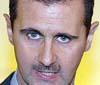
Syrian President Bashar Assad is at a political crossroad. For the moment he is basking in the glory of Hezbollah's victory in a month-long war the Shiite militia fought with Israel. Although Syria did not directly partake in active combat operations, Damascus has been time and again accused by the United States, and by Israel, of supporting Hezbollah. |
|
|

| The content herein, unless otherwise known to be public domain, are Copyright 1995-2006 - SpaceDaily.AFP and UPI Wire Stories are copyright Agence France-Presse and United Press International. ESA PortalReports are copyright European Space Agency. All NASA sourced material is public domain. Additionalcopyrights may apply in whole or part to other bona fide parties. Advertising does not imply endorsement,agreement or approval of any opinions, statements or information provided by SpaceDaily on any Web page published or hosted by SpaceDaily. Privacy Statement |