|
 |
 |
 |
 |
 |
 |
 |
 |

 |
German Teacher Discovers New Comet In SOHO Data
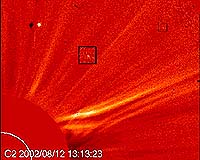
Hamburg - Aug 20, 2002 For 40 years already Rainer Kracht observes the starlit sky and concerns himself with astronomy. But the dream of each amateur astronomer, the discovery of a comet, remained refused to him for a long time. He did not strive for it, anyway though. "The conventional search with optical telescopes is offering no prospects in Northern Germany", says the 54 years old teacher from Elmshorn, a small town near Hamburg. Too much scattered light obstructs the observations. But one does not need to look towards the sky. Meanwhile comets can be discovered on the Internet, too. And that is where Kracht now succeeded again: In the data of the solar probe SOHO (solar Heliospheric Observatory) he identified the 500th comet. "That was not more exciting than the 499th comet", he says, trying to put the significance of the event into the right place. But the discovery of the 500th comet has been expected already for some time, and the operators of SOHO, the European space organization ESA and its American partner NASA, had even organized a competition to predict the time of the discovery most exactly. That has contributed to making Krachts name now known all over the world. Actually the probe SOHO, which is stationed since the end of 1995 in 1.5 million kilometers distance of the earth, serves the permanent observation of the sun. For this it is equipped among other things with the instrument LASCO (Large Angles and Spectrometric Coronagraph), which takes the sun disk off as with a total solar eclipse, in order to examine the otherwise over-radiated closer environment of the sun. As a side effect this equipment also makes comets visible, which normally would remain unnoticed so close to the sun. Since the pictures taken up by LASCO are published shortly after their receipt on earth on the Internet, it is open to amateur astronomers to look for signatures of comets. That is not always simple. "The pictures have much noise", says Kracht. "Not every light spot does result from a comet." Who believes to have discovered a new comet can register the appropriate data in a form on the Internet. The data are then examined and either confirmed or rejected. Kracht, who is teaching mathematics, physics, computer science and occasionally also astronomy for 26 years at the Gesamtschule Elmshorn, learned about this possibility of comet searching at the end of 2000 by an article in the magazine "Sky & Telescope". However, his computer at that time was not efficient enough, in order to be able to keep up with the other comet hunters. But for approximately one year now he uses a faster Internet access and was able to discover 63 comets. That gives him the second place among the SOHO comet hunters. Only Mike Oates from Manchester succeeds him with 136 hits altogether. One comet family - comets, which move on a similar orbit and are interpreted as fragments of a larger object - is even named after Kracht. The scientists, who conceived the probe, did not expect SOHO would enrich the comet research to such extent. "They were a wonderful surprise, of the kind we get in science sometimes", says ESA project scientist Bernhard Fleck. "I remember the possibility being mentioned when we were preparing the spacecraft that we might discover one or two comets each year." These expectations were exceeded by roughly two orders of magnitude and led to new knowledge in particular concerning the sizes of comets. "We found out that comets can be both extremely large and extremely small. Nearly all of the SOHO discoveries are what we call sungrazers. They hit the Sun's atmosphere and disappear. They are quite small, typically only about 10 metres in diameter. And most of them come from the same direction in space, because they're fragments of a really huge comet. "Big fragments were seen by the ancient Greeks, more than 2000 years ago. The original comet must have been enormous to create so much debris - probably more than 100 kilometres in diameter and well visible even during daylight." For the amateur comet hunters however there is one aspect that might spoil the joy about the discovery: The discovered comets get so close to the sun that they are usually destroyed. "Occasionally, I am asked, when my comets could be observed in the evening sky", says Kracht. "Then I must answer, unfortunately: never again." Dr. Hans-Arthur Marsiske is a freelance journalist based in Germany he can be contacted via his website at http://www.hamarsiske.de/english/start.htm Community Email This Article Comment On This Article Related Links Kracht�s website Interview with Bernhard Fleck Internet form for new comet discoveries SOHO at ESA SpaceDaily Search SpaceDaily Subscribe To SpaceDaily Express Asteroid and Comet Mission News, Science and Technology
 NASA'S Spitzer Finds Possible Comet Dust Around Dead Star
 Pasadena CA (SPX) Jan 12, 2006
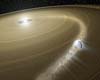
NASA's Spitzer Space Telescope has spotted what may be comet dust sprinkled around the white dwarf star G29-38, which died approximately 500 million years ago. |
|
|

| The content herein, unless otherwise known to be public domain, are Copyright 1995-2006 - SpaceDaily.AFP and UPI Wire Stories are copyright Agence France-Presse and United Press International. ESA PortalReports are copyright European Space Agency. All NASA sourced material is public domain. Additionalcopyrights may apply in whole or part to other bona fide parties. Advertising does not imply endorsement,agreement or approval of any opinions, statements or information provided by SpaceDaily on any Web page published or hosted by SpaceDaily. Privacy Statement |