|
 |
 |
 |
 |
 |
 |
 |
 |

 |
Geologists Discover Clockwork Motion By Ocean Floor Microplates
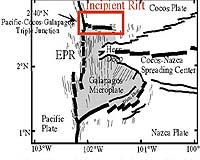
Durham NC (SPX) Feb 24, 2005 A team of geologists from Duke University and the Woods Hole Oceanographic Institution has discovered a grinding, coordinated ballet of crustal "microplates" unfolding below the equatorial east Pacific Ocean within a construction zone for new seafloor. The scientists deduced that relatively small sections of the ocean floor there, and perhaps in other similar places, may be slowly rotating like imperfectly meshing cogs in a machine. The unexpected findings provide new insights into the way several ocean ridge segments that border the microplates evolved into their current positions to form part of what is known as a "triple junction," according to the researchers. And these results may be applicable to systems elsewhere, they added. "As often happens in science, what you think you're going to learn doesn't always end up being the exciting thing that you learn," said Emily Klein, the Lee Hill Snowdon Professor at Duke's Nicholas School of the Environment and Earth Sciences, who is the lead author of a report on the findings published in the Thursday, February 24, 2005 issue of the journal Nature. Other authors include Deborah Smith, Clare Williams and Hans Schouten of the Woods Hole Oceanographic Institution in Massachusetts. The group's study, begun aboard the San Diego-based research ship R/V Melville, was supported by the National Science Foundation. Klein, whose specialty is geochemistry, said the scientists' original focus was the chemistry and structure of the Incipient Rift, the smallest and newest of four ocean ridge segments in a region of the ocean floor northwest of the Galapagos Islands. Ocean ridges are linear features on the ocean floor where molten magma originating in the earth's mantle rises and solidifies to form new ocean crust. The Incipient Rift and other ridge segments in the area intersect with the East Pacific Rise, part of a globe-circling mid-ocean ridge system and the region's largest ocean crust producer. All these intersecting ridge segments also form parts of boundaries separating what the study revealed to be subsections of the Galapagos Microplate, which wedges between three other larger plates in the region's complex ocean floor topography. "The exciting story is about the tectonics and the kinematics of the whole Galapagos microplate, which before our cruise was little understood," Klein said in an interview. Tectonics are the crustal deformation of plates; kinematics describe their motion over the mantle. "The Galapagos microplate shares a complex plate boundary configuration with the surrounding Cocos, Nazca and Pacific plates. We learned a lot on this cruise and have many new questions to pursue," Smith said of the study. At the outset, the scientists grew puzzled when they began analyzing data from sensitive sonar beams they were using to map the extremely jumbled terrain of previously uncharted geological features along the Incipient Rift. A previous study by other researchers led them to expect that rift would grow consistently wider, in the manner of a ship's wake, as they mapped increasingly eastward from the East Pacific Rise. Instead, their sonar imaging showed the rift becoming narrower and deeper as their distance from the East Pacific Rise grew larger. Narrowing at both ends and widest in the middle, the trough thus assumed the overall shape of an elongated diamond - which they termed a "lozenge." That finding implied that more complex dynamics are at work there, said Klein. Meanwhile, underwater photography and rock magnetic measurements by the group suggested that molten lava was periodically erupting within the area where the Incipient Rift re-narrows. Such eruptions would provide further evidence for "active rifting and continuing reorganization of the microplate's boundary," Klein said. Using those collective observations, Smith, Schouten and Williams of Woods Hole applied their own expertise in modeling to deduce the likely present, past and future motion of the Incipient Rift and the Galapagos microplate it borders. In the process, the scientists found that "what was previously considered one coherent microplate must, in fact, form two separate microplates," according to the Nature report. They also deduced that those separate Galapagos microplates should be "rotating," and turning "in opposite directions." Duke's Klein and the Woods Hole modelers then went on to infer the kinematics of these contiguous microplates. Both microplates appeared to be turning - the northern one counter-clockwise and the southern one clockwise - in a coordinated way, reported the Nature report's authors, who located likely rotating points on each of the three ocean ridge segments. Eventually, further rifting may force the Incipient Rift to cut further from the East Pacific Rise in a direction that pierces the walls of an adjoining rift. If that happens, the "driving torque" will cease, "and the microplates will stop rotating," the Nature report authors predicted. "It's like ball bearings moving past each other," Klein said. "This finding has huge implications for how complex plate boundaries interact and evolve and change their orientations and kinematics through time." The key is "edge driven" action caused by the microplate rotations, according to the paper. But what drives the rotations themselves remains "truly an unanswered question," Klein acknowledged. Community Email This Article Comment On This Article Related Links Duke University Duke Incipient Rift Cruise Report Woods Hole Oceanographic Institution SpaceDaily Search SpaceDaily Subscribe To SpaceDaily Express Tectonic Science and News
 Ash Continuing To Spew From Vanuatu Volcano
 Sydney (AFP) Dec 12, 2005
Thousands of tonnes of ash are continuing to spew from a volcano in Vanuatu, but officials said Monday the activity on the South Pacific nation was not likely to result in a major deadly eruption. |
|
|

| The content herein, unless otherwise known to be public domain, are Copyright 1995-2006 - SpaceDaily.AFP and UPI Wire Stories are copyright Agence France-Presse and United Press International. ESA PortalReports are copyright European Space Agency. All NASA sourced material is public domain. Additionalcopyrights may apply in whole or part to other bona fide parties. Advertising does not imply endorsement,agreement or approval of any opinions, statements or information provided by SpaceDaily on any Web page published or hosted by SpaceDaily. Privacy Statement |