|
 |
 |
 |
 |
 |
 |
 |
 |

 |
First Inflatable Spacecraft Mission Continues Problem Free
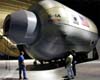
SpaceDaily US Editor Las Vegas NV (SPX) Jul 14, 2006 Bigelow Aerospace has announced that the Genesis I prototype spacecraft successfully inflated and its solar arrays are deployed and supplying power to the onboard instruments. "All Systems are operating within expected parameters," said Robert T. Bigelow, the company's founder. "Temperature, avionics, solar arrays and battery power all remain positive. "All of our initial orbits have had direct sunlight, which has helped in charging the main battery to maximum capacity." Bigelow added. Genesis I was launched Wednesday aboard a Russian Dnepr rocket from Dombarovsky missile base in Siberia. As the spacecraft achieved its designed orbit of 550 kilometers (340 miles) a short time later, computer-controller air-pressure tanks activated and expanded the pre-folded structure into its watermelon shape. The one-third-scale prototype is 4.5 meters (15 feet) long with a diameter of 2.4 meters (8 feet). The tough fabric shell is made of a composite of Kevlar - used to make bullet-proof vests - and an advanced material called Vectran. The spacecraft's planned operational lifetime is five years, during which technicians will determine if Genesis can maintain the proper internal air pressure and temperature, whether it can withstand any collisions with space debris and micrometeorites, and whether solar radiation causes any deterioration of the airtight fabric. Bigelow said the internal temperature currently is a comfortable 78 degrees Fahrenheit (26 degrees Celsius), and air pressure is within normal limits. Genesis carries live insect colonies, whose health will be monitored during the mission. Ground controllers have acquired the spacecraft's Global Positioning System signal that will enable them to track its orbit. "We have had multiple contacts with the ship," Bigelow said, "and received several data streams. While most of these current communication streams are dedicated to command and control of the spacecraft, we have downloaded several small images from the onboard cameras and hope to get more as more bandwidth in the data stream becomes available." The company plans to send another inflatable prototype into orbit this fall. It will carry insects as well, plus the photographs and personal items of paying customers. Genesis II also will carry multiple cameras for the purpose of recording those items floating by in the spacecraft's interior. "Every day, Bigelow Aerospace will be downloading images and video from these cameras," the company said on its Web site. "If you log onto the Bigelow Aerospace Web portal, you will have a chance to actually see your item floating by." Eventually, Bigelow wants to put a multi-module version of Genesis into orbit to serve as the first space hotel, hosting private tourists. Toward that end, he has established America's Space Prize, a $50-million award to the first private spacecraft that can carry five passengers and crew to an altitude of 400 kilometers (250 miles) by 2010. Community Email This Article Comment On This Article Related Links Bigelow Aerospace Space Tourism, Space Transport and Space Exploration News
 Russia Launches Inflatable Test Satellite From Urals
 Moscow (RIAN) Jul 13, 2006
Russia has conducted a launch of an RS-20 Voyevoda (SS-18 Satan) intercontinental ballistic missile from a silo in the Urals, the press service of the Strategic Missile Forces said Wednesday. |
|
|

| The content herein, unless otherwise known to be public domain, are Copyright 1995-2006 - SpaceDaily.AFP and UPI Wire Stories are copyright Agence France-Presse and United Press International. ESA PortalReports are copyright European Space Agency. All NASA sourced material is public domain. Additionalcopyrights may apply in whole or part to other bona fide parties. Advertising does not imply endorsement,agreement or approval of any opinions, statements or information provided by SpaceDaily on any Web page published or hosted by SpaceDaily. Privacy Statement |