|
 |
 |
 |
 |
 |
 |
 |
 |

 |
Gemini Samples Spectrum Of 2003 UB313: Pluto-Like Surface
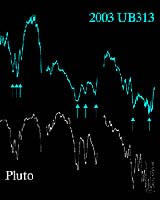
Washington DC (SPX) Jul 31, 2005 The Gemini Observatory has obtained a preliminary spectrum of 2003 UB313, the lastest so-called "10th planet". These observations were obtained on January 25, 2005 by Chad Trujillo, a Gemini staff member who is also on the discovery team for 2003 UB313, the existence of which was formally announced by the Minor Planet Center in Cambridge, MA on July 29, 2005. The discovery team (Mike Brown of Caltech, Chad Trujillo of Gemini and David Rabinowitz of Yale) are still uncertain of the exact size of the body, but report that it must be Pluto-sized or larger. The body is the most distant solar system body known to orbit the sun at 97 AU from the sun, over 3 times farther away than planet Pluto. The "planet" was originally discovered in late December 2004 with data collected from the Samuel Oschin 1.2 meter telescope at Palomar Mountain, CA. To better characterize the surface of the object the team obtained spectra with NIRI (the near-infrared spectrograph) on the much larger 8 meter Gemini North telescope on Mauna Kea, Hawaii. The NIRI spectra shows strong signatures of methane ice, remarkably similar to the spectrum of Pluto, which is also dominated by methane ice in near-infrared observations. Figure 2 shows the spectra of Pluto and 2003 UB313, with arrows marking the "dips" that correspond to methane features. The same features are readily apparent in both the Pluto and the 2003 UB313 spectra. Trujillo states, "We still do not know much about this object, however, it is clear that it is very similar to Pluto in both size and composition, at least upon first glance." The presence of methane ice is unusual in that it indicates a primitive surface that has not likely been heated significantly since the solar system formed 4.5 billion years ago. "If 2003 UB313 ever got close to the sun, all the methane ice would have boiled off immediately," Trujillo continued. "To date, no one has seen methane on any other Kuiper Belt Object, only on Pluto and Neptune's moon Triton." The distant Kuiper Belt is a collection of bodies orbiting the sun beyond Neptune, and is likely the parent population to the comets. The team have also obtained spectra of the smaller mini-planet 2003 EL61, which was reported on July 28, 2005 by two independent teams: one from the Sierra Nevada Observatory in Spain and the Brown, Trujillo and Rabinowitz team. This object is smaller than Pluto, but shows strong water-ice features, similar to what is seen on the surface of Pluto's moon Charon. Results will be reported in detail at the 37th annual meeting of the Division for Planetary Sciences of the American Astronomical Society in September 2005 at the University of Cambridge, UK. Community Email This Article Comment On This Article Related Links Gemini Observatory SpaceDaily Search SpaceDaily Subscribe To SpaceDaily Express The million outer planets of a star called Sol
 Scientists Show Pluto To Be Colder Than It Should Be
 Cambridge MA (SPX) Jan 5, 2006
Mercury is boiling. Mars is freezing. The Earth is just right. When it comes to the temperatures of the planets, it makes sense that they should get colder the farther away they are from the Sun. But then there is Pluto. It has been suspected that this remote world might be even colder than it should be. Smithsonian scientists now have shown this to be true. |
|
|

| The content herein, unless otherwise known to be public domain, are Copyright 1995-2006 - SpaceDaily.AFP and UPI Wire Stories are copyright Agence France-Presse and United Press International. ESA PortalReports are copyright European Space Agency. All NASA sourced material is public domain. Additionalcopyrights may apply in whole or part to other bona fide parties. Advertising does not imply endorsement,agreement or approval of any opinions, statements or information provided by SpaceDaily on any Web page published or hosted by SpaceDaily. Privacy Statement |