|
 |
 |
 |
 |
 |
 |
 |
 |

 |
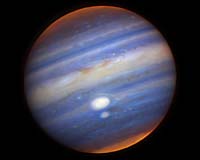
Gemini Captures Close Encounter Of Two Jupiter Red Spots
Hilo HI (SPX) Jul 25, 2006 A high-resolution image released today by the Gemini Observatory shows two giant red spots brushing past one another in Jupiter's southern hemisphere. The image was obtained in near infrared light using adaptive optics which corrects, in real-time, for most of the distortions caused by turbulence in Earth's atmosphere. The result is a view from the ground that rivals images from space. "It was tricky getting this image," said Gemini astronomer Chad Trujillo who helped lead the effort to capture the event. "Since we used adaptive optics we needed a star-like object nearby to guide on, so we had to find a time when Jupiter's moon Io would appear close enough to Jupiter and the red spots would be optimally placed on Jupiter's disk. Fortunately it all worked out on the evening of July 13th and we were able to capture this relatively rare set of circumstances." Both red spots are massive storm systems. The top of the larger one, known for a long time as the Great Red Spot, lies about 8 kilometers (5 miles) above the neighboring cloud tops and is the largest hurricane known in the solar system. The smaller storm (officially called Oval BA, but informally known as Red Spot Junior) is another hurricane-like system. Since it appears nearly as bright as the Great Red Spot in near-infrared images, Red Spot Junior may be at a similar height in Jupiter's atmosphere as the Great Red Spot. Red Spot Junior is roughly half the size of its famous cousin, but its winds blow just as strong. This mighty new storm formed between 1998 and 2000 from the merger of three long-enduring white ovals, each a similar storm system at a smaller scale, which had been observed for at least 60 years. It was not until Feb. 27 of this year, however, that Philippine amateur astronomer Christopher Go discovered that the color of the newly formed white oval had turned brick red. Astronomers were witnessing the birth of a new red spot. No one is certain why this white oval turned red, but University of Hawai'i astronomer Toby Owen supports a hypothesis developed by New Mexico State University astronomer Rita Beebe, who suggests that the merger of the three white ovals led to an intensified storm system. This made it strong enough to dredge up reddish material from deeper in the atmosphere. As this material welled up in the middle of the spot, it is contained (or protected) from escape by the strong circulating currents at the spot's edges. "What's frustrating is that we don't know what this reddish material is," Owen said. "But it appears that the ability to dredge it up depends on the size of these oval storm systems." Another popular hypothesis contends the material dredged up from below Jupiter's visible clouds climbs to an altitude where the Sun's ultraviolet light chemically alters it to give it a reddish hue. Nothing dramatic is expected to happen as the two storm systems continue their close encounter. The white ovals from which Red Spot Junior is made have passed by the Great Red Spot countless times as the atmospheric current in which they are embedded moves at a different speed from the one at the latitude of the Great Red Spot. Nevertheless, Owen said, there remains the possibility that the Great Red Spot could now, or in the future, push Red Spot Junior into a southern jet stream that is blowing against the storm's counterclockwise rotation. If Red Spot Junior's spin slows, its color could revert back to white - though scientists are not sure. Right now, as the Gemini image shows, Red Spot Junior is demonstrating its staying power. Each red spot is rotating with Jupiter at slightly different rates and over time, like passing cars on a highway, the two spots change relative positions causing periodic close passages like this. However, this is the first such passage since the new, smaller red spot intensified and turned red. A recent optical image from the Hubble Space Telescope was obtained in April of this year when the two spots were still separated by a considerable distance. The Gemini image was produced by Travis Rector of the University of Alaska Anchorage, Chad Trujillo of Gemini Observatory and the Gemini ALTAIR adaptive optics team. Gemini Observatory is an international partnership managed by the Association of Universities for Research in Astronomy under a cooperative agreement with the National Science Foundation. Community Email This Article Comment On This Article Related Links Gemini Observatory Jupiter and its Moons Explore The Ring World of Saturn and her moons The million outer planets of a star called Sol News Flash at Mercury
 Gas Giants Consistently Larger Than Their Moons
 Boulder CO (SPX) Jun 15, 2006
Each of the solar system's outer gaseous planets hosts a system of multiple satellites, and these objects include Jupiter's volcanic Io and Europa with what is thought to be a sub-surface ocean of water, as well as Titan with its dense and organic-rich atmosphere at Saturn. |
|
|

| The content herein, unless otherwise known to be public domain, are Copyright 1995-2006 - SpaceDaily.AFP and UPI Wire Stories are copyright Agence France-Presse and United Press International. ESA PortalReports are copyright European Space Agency. All NASA sourced material is public domain. Additionalcopyrights may apply in whole or part to other bona fide parties. Advertising does not imply endorsement,agreement or approval of any opinions, statements or information provided by SpaceDaily on any Web page published or hosted by SpaceDaily. Privacy Statement |