|
 |
 |
 |
 |
 |
 |
 |
 |

 |
Gates To Follow Clark Clifford's Footsteps
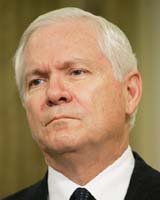
UPI Senior News Analyst Washington (UPI) Nov 15, 2006 Robert Gates looks fated as the next U.S. secretary of defense to play the same kind of role in reassessing the Iraq war as his predecessor Clark Clifford did over Vietnam nearly 40 years ago. The Nov. 7 congressional midterm elections returned Democratic majorities to control both in the U.S. House of Representatives and the Senate. The very next day, President George W. Bush fired his powerful warlord, Defense Secretary Donald Rumsfeld, who was committed to "staying the course" in Iraq and he announced he was replacing Rumsfeld with Gates, a former director of the Central Intelligence Agency under President George H. W. Bush, the current president's father, and a member of the James A. Baker-Lee Hamilton Iraq Study Group. That means the Tet moment has finally arrived in America over the Iraq war. The Tet offensive of early 1968 in South Vietnam was the worst military defeat the Viet Cong ever suffered and as an independent guerrilla force they never recovered from it. Tet was an overwhelming military victory for the U.S. Army and for the Army of the Republic of South Vietnam. But it was a strategic and political defeat for the United States that ultimately lost the war. For the dramatic impact of Tet convinced key swing elements of the American public, media policymakers and finally President Lyndon Baines Johnson that things were gravely wrong in South Vietnam and that it was time to change direction. Tet started a political dynamic in the United States that ultimately led first to the full withdrawal of all U.S. ground combat forces from South Vietnam by President Richard Nixon by the end of 1972. Eventually, following Nixon's fall in the Watergate scandal, it led to the political castration of his successor, President Gerald Ford, so that Ford was unable to commit significant U.S. forces or prevent the conquest of South Vietnam by North Vietnamese ground forces in 1975. The recent heavy fighting in Baghdad between U.S. forces and Shiite militias has finally brought U.S. public opinion and even the previously inflexible Bush to their "Tet" moment on Iraq. As was the case after Tet, the sitting U.S. president and his policymakers do not concede that the war is lost, but they finally have recognized that it would be lost if they continued doing what they have been doing, that it may still be lost, and that in any case, some major change of direction is essential. Outgoing Defense Secretary Rumsfeld has long been compared by his many critics to his predecessor Robert McNamara, who disastrously micro-managed and mismanaged American strategy and combat operations in South Vietnam 40 years ago. Now Gates, Rumsfeld's already-picked successor, looks fated to play the same role as Clark Clifford, whom an embattled President Johnson chose as McNamara's successor. Like Clifford, Gates is a decades-long member of the ruling political establishment in Washington. He is neither an expert on the U.S. military, on the conduct of war, or on the history and politics of the country where the war is being waged. But like Clifford, he is an immensely experienced, moderate pragmatist whose instinct will be not to make dramatic U-turns or sweeping reversals of policy. However, like Clifford, he may be forced by recognizing harsh realities to make highly significant changes in the strategic direction of the war he inherited. It seems highly likely from what sources close to Gates and to his close friend, former Secretary of State Baker, have told UPI that Gates at this point in time would prefer not to commit to a total U.S. military withdrawal from Iraq or admission of defeat there. They say he would prefer to significantly reduce U.S. forces in Iraq in the short term, but that he will not enter office tied to any firm commitment to do so. Any public speculations to the contrary that may appear in the media would be jumping the gun and wildly premature, these sources said. It is impossible to predict with confidence what Gates will do on Iraq since he cannot know that yet himself, they said. Gates, like any serious executive who takes over a company in crisis, or any major political leader or national administrator who takes over direction of a major government department or the conduct of a major conflict like Iraq, knows that he will have to master a mountain of confidential data and will have to deal with rapidly evolving political and military realities. These conditions mean that it is impossible to predict in advance what pressures and realities Gates will have to deal with when he takes office. What is clear, however, is that, as we noted in a UPI analysis last week, Gates will make his decision-making on the Iraq war and prepare his recommendations to the president very differently from the way his predecessor Rumsfeld did business. A Platonist idealist who believed he could bulldoze through or ride roughshod over intractable harsh realities in Iraq is being replaced by a cautious, process-driven Aristotelian pragmatist. Had Gates been appointed three or even two years ago, he might have defused the war, won it, or achieved a strategic solution satisfactory to basic U.S. national interests without having to achieve any outright military victory. Instead, he inherits a metastasizing Sunni insurgency, out of control Shiite militias and a politically and strategically isolated, exhausted U.S. Army caught between them that is woefully under-strength for the tactical responsibilities it still must shoulder. The problems that faced Clark Clifford almost 40 years ago look almost mild by comparison.
Source: United Press International Community Email This Article Comment On This Article Related Links Iraq: The first techonology war of the 21st century Iraq: The first technology war of the 21st century
 Bush In Hanoi: Vietnamese Lessons For Iraq
 Hanoi, Vietnam (RIA Novosti) Nov 17, 2006
On November 18-19, George W. Bush will attend the summit of the Asia-Pacific Economic Cooperation forum in Vietnam, the country where his predecessors were defeated in a war more than 30 years ago. The U.S. president will make the trip soon after his party's failure to maintain control of Congress because of the country's unsuccessful strategy in Iraq. |
|
|

| The content herein, unless otherwise known to be public domain, are Copyright 1995-2006 - SpaceDaily.AFP and UPI Wire Stories are copyright Agence France-Presse and United Press International. ESA PortalReports are copyright European Space Agency. All NASA sourced material is public domain. Additionalcopyrights may apply in whole or part to other bona fide parties. Advertising does not imply endorsement,agreement or approval of any opinions, statements or information provided by SpaceDaily on any Web page published or hosted by SpaceDaily. Privacy Statement |