|
 |
 |
 |
 |
 |
 |
 |
 |

 |
Gamma Rays From Thunderstorms?
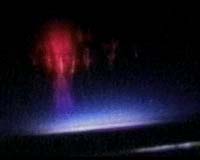
Durham NC (SPX) May 03, 2005 Duke University engineers have led the most detailed analyses of links between some lightning events and mysterious gamma ray emissions that emanate from earth's own atmosphere. Their study suggests that this gamma radiation fountains upward from starting points surprisingly low in thunderclouds. Counter-intuitively, these strong gamma outbursts also seem to precede associated lightning discharges by a split second. "All of this comes as a huge surprise," said Steven Cummer, an assistant professor of electrical and computer engineering at Duke's Pratt School of Engineering. "These are higher energy gamma rays than come from the sun. And yet here they are coming from the kind of terrestrial thunderstorm that we see here all the time." Cummer, Pratt School graduate student Wenyi Hu and postdoctoral researcher Yuhu Zhai described their analyses in a paper published online Saturday, April 30 in the journal Geophysical Research Letters. Other co-authors include David Smith of the University of California, Santa Cruz; Liliana Lopez of the University of California, Berkeley; and Mark Stanley of Los Alamos National Laboratory in New Mexico. The research was funded by the National Science Foundation. Natural emissions of gamma rays, the most energetic forms of light, are usually triggered only by high-energy events in outer space. Such events include thermonuclear reactions within the sun, interactions between cosmic rays and black-hole-creating star collapses. But in 1994, scientists using the Compton Gamma Ray Observatory satellite first detected gamma rays seemingly originating near the earth's surface. And researchers quickly found evidence that those emissions were connected to lightning, Cummer said. Beginning in 2002, the Reuven Ramaty High Energy Solar Spectroscopic Imager (RHESSI) satellite - launched to study x-rays and gamma rays from the sun -also began detecting larger numbers of what scientists began terming terrestrial gamma ray flashes (TGFs). Smith and Lopez were two of the four authors of a February 2005 paper in the journal Science that first described RHESSI-detected TGFs, and also corroborated those with lightning frequency data. In the new Duke-led study, Cummer and his assistants made what he termed "very careful and continuous recordings" of lightning emissions in a targeted area over a four month period of 2004. By analyzing those records, they identified lightning episodes they could link in time and place to TGFs recorded by RHESSI in the tropical Caribbean region. "We quantify the lightning-TGF relationship in detail and attempt to constrain the possible source mechanisms," the authors wrote in Geophysical Research Letters. Cummer's team analyzed data from two specialized instruments installed in Duke Forest, an outdoor research reserve near the university's campuses. One of those devices performs sensitive long-range measurements of radio waves in the Very Low Frequency and Extremely Low Frequency bands - from 50 to 30,000 and 3 to 3,000 hertz (cycles per second) respectively. The other instrument is sensitive to even lower frequencies, ranging from less than 0.1 to 400 hertz. Cummer originally installed these radio wave detectors to perform long range studies tying Midwestern thunderstorms with the creation of ghostly, brief flashes in the upper atmosphere, known as "sprites." "RHESSI didn't detect any TGFs in the Midwestern U.S. where people detect sprites," Cummer said. "But there were a lot of TGFs in Indonesia, Africa and the American Caribbean area. Of those, the Caribbean is 2,000-4,000 kilometers from our sensors - in the scale of things actually quite close. So we were able to say with very strong certainty whether lightning happened in the Caribbean at a specific time." Their analysis raised major questions about how well the connection between lightning and gamma rays could be explained by a favored hypothesis known as "runaway breakdown," Cummer said. Runaway breakdown begins with collisions between extraterrestrial cosmic rays and the atmosphere, which generates a few very high energy electrons. A sufficiently strong electric field can further accelerate these electrons. That can cause additional collisions, producing more high energy electrons until "the whole process avalanches," he said. Such an electron avalanche in the electrical field immediately following a strong lightning discharge could create a high energy electron beam at altitudes of between 30 and 50 kilometers, according to the hypothesis. That beam would then produce gamma rays as it interacts with the atmosphere. "If this were the operating mechanism, we should see enormous lightning strokes associated with every one of those TGFs," Cummer said. "But we found that this was unequivocally not the case." Instead, the lightning strokes his group analyzed were 50-500 times smaller than what should be required to create TGFs by runaway breakdown, according to the Geophysical Research Letters report. Their report suggested that runaway breakdown at a much lower altitude, created within "strong fields in or just above the thundercloud," could have triggered the TGFs instead. "It still almost certainly has to be runaway breakdown that's creating these," Cummer said. "The only real possibility is that it's much closer to the cloud top, and linked to something else happening inside the cloud." The detailed Duke-led analysis also disclosed that, on average, TGFs occurred 1.24 milliseconds before their associated lightning strokes. "That was something we absolutely were not expecting," Cummer said. "But the coincidence between the lightning and the TGFs we found is too good to be random. So, even if the TGFs precede the lightning, they are in some way connected." Their paper suggests one possibility for such a negative cause-and-effect relationship. Perhaps "TGFs are produced by a process associated with the development of the observed lightning stroke, but that actually occurs about 1 millisecond before the stroke itself," the authors wrote. Cummer says his Duke group is now building cheaper and more portable versions of both kinds of low frequency radio detectors. He hopes to someday install those closer to satellite-observed TGF hot spots in the Caribbean region in order to make even more detailed observations. "We now know where to go, because RHESSI has told us where these things happen," he said. Community Email This Article Comment On This Article Related Links Duke's Pratt School of Engineering Duke University SpaceDaily Search SpaceDaily Subscribe To SpaceDaily Express Space Technology News - Applications and Research
 TeleRay Mobile Sat TV Antenna For Japan Auto Market
 Las Vegas CA (SPX) Jan 5, 2006
RaySat has introduced TeleRay, the world's smallest satellite TV vehicle antenna, into the domestic Japanese automotive market. |
|
|

| The content herein, unless otherwise known to be public domain, are Copyright 1995-2006 - SpaceDaily.AFP and UPI Wire Stories are copyright Agence France-Presse and United Press International. ESA PortalReports are copyright European Space Agency. All NASA sourced material is public domain. Additionalcopyrights may apply in whole or part to other bona fide parties. Advertising does not imply endorsement,agreement or approval of any opinions, statements or information provided by SpaceDaily on any Web page published or hosted by SpaceDaily. Privacy Statement |