|
 |
 |
 |
 |
 |
 |
 |
 |

 |
Galileo Swims In Radiation Soup To Take Closeups Of Jovian Inner Moons
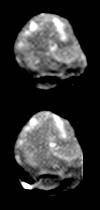
Ithaca - April 24, 2000 - The Galileo spacecraft has taken a risky spin through Jupiter's lethal radiation belts to capture the highest-resolution images yet of three of the planet's four innermost moons, Thebe, Amalthea and Metis. In particular, two views of Jupiter's 250-kilometer-long (155 miles), irregularly shaped moon Amalthea, obtained by Galileo's Solid State Imaging camera (SSI) last August and November, show for the first time that a bright surface feature named Ida is a streak of bright material, about 50 kilometers (31 miles) in length. The images were obtained by Galileo's Imaging Science Team, led by Michael Belton of the National Optical Astronomy Observatories in Tucson, Ariz., working with NASA's Jet Propulsion Laboratory (JPL) in Pasadena, Calif., the manager of the mission. The images were enhanced by a group led by Damon Simonelli, a research associate in Cornell University's Center for Radiophysics and Space Research (CRSR). Other members of the Cornell group were astronomy professor Joseph Veverka, CRSR researcher Peter Thomas and undergraduates Nirattaya Khumsame and Laura Rossier. The spacecraft, launched in 1989, dribbled back the image data over several months using a single low-power antenna -- early in the mission, the main, umbrella-shaped, high-gain antenna on the spacecraft had failed to open. Indeed, the story of how the images of the inner moons were received competes for interest with the images themselves. Before last summer, says Simonelli, each elliptical orbit of the spacecraft took it no closer to Jupiter than the path of the moon Europa, 700,000 kilometers from the planet's center, keeping Galileo well away from the heart of the magnetic fields and charged particles in the close-in radiation belts. Because of the late stage of the mission, JPL decided to lower the orbit and risk three flybys of the volcanically active moon Io, 300,000 kilometers closer to Jupiter's center. This brought Galileo closer than ever before to the moons inside Io's orbit, Thebe, Amalthea and tiny Metis, only 100,000 to 200,000 kilometers from the planet's center. The fourth inner moon, the tiny Adrastea, was not imaged during these risky maneuvers. Due to the slow rate of data transmission with the single antenna -- just 40 bits a second compared with roughly 100,000 bits a second with a high-gain antenna -- the researchers designed a two-part strategy for receiving the image data stored on the spacecraft's digital tape recorder. The imaging data -- along with infrared and ultraviolet data from other Galileo instruments -- are not stored permanently, but are erased on the spacecraft's subsequent orbit as the instruments capture new data. Thus, as the spacecraft sped toward the far reaches of its elliptical orbit after capturing the images of the moons, the data were relayed in highly compressed form -- sacrificing detail but greatly reducing downlink time, giving researchers a chance to learn where the moons were located within each camera frame. From this, researchers were able to decide what portion of each image they wanted relayed in full-resolution form. This was done as the spacecraft sped back toward Jupiter for its next orbit. For example, new views of Thebe, Amalthea and Metis were captured Jan. 4, and the highly compressed data were relayed by Jan. 25. The team then had to wait anxiously until Feb. 14 for the second set of data -- containing selected, small windows -- to be played back. These raw data were filtered by computer software to remove "noise," caused by charged particles striking the camera's light-sensitive charge-coupled device. Then, through a computer process of enhancement, the full quality of the images of the moons was slowly revealed. Simonelli says he is "particularly excited" about what last August's and November's images reveal about Ida, the surface feature on Amalthea that in previous spacecraft images taken from other viewing directions appeared as a round, bright "spot." The long, bright streak now revealed could be, he says, ejecta from a nearby meteoroid impact crater or simply mark the crest of a local ridge. Other patches of relatively bright material, he says, can be seen elsewhere on Amalthea, although none has Ida's linear shape. These images of Amalthea also reveal a large meteoroid impact crater about 40 kilometers (25 miles) across. Two ridges, tall enough to cast shadows, extend from the top of the crater in a V-shape, reminiscent of two rabbit ears. The January images of the three moons show surface features as small as 2 kilometers (1.25 miles) across. A prominent impact crater on Thebe is about 40 kilometers across and has been given the provisional name Zethus (in Greek mythology, the husband of Thebe). A large white region near the south pole of Amalthea is the brightest patch of surface material seen anywhere on the three moons. Its composition is unknown. It sits inside a large crater named Gaea. As a comparison, the Simonelli team also is releasing a montage of images of the moons taken in November 1997 from approximately 700,000 kilometers from Jupiter's center as the spacecraft was completing its first two years in orbit. The new and old images show startling contrasts in detail. And yet both sets of images are remarkable considering that before Galileo, moons such as Thebe and Metis were seen as no more than specks of light.
Email This Article Comment On This Article Related Links Space
 Satellite Launch To Boost DTH In India
 Calcutta, India (SPX) Dec 28, 2005
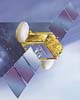
The successful launch Thursday of India's heaviest satellite from spaceport of Kourou in French Guyana may have boosted the country's space research efforts to yet another level, but it has also lifted the spirits of at least three Direct-To-Home televisions broadcasters, one of which has been waiting for years to launch its services in India. |
|
|

|
|
|
|
|
|
|
|
|
|
|
|
| The content herein, unless otherwise known to be public domain, are Copyright 1995-2006 - SpaceDaily.AFP and UPI Wire Stories are copyright Agence France-Presse and United Press International. ESA PortalReports are copyright European Space Agency. All NASA sourced material is public domain. Additionalcopyrights may apply in whole or part to other bona fide parties. Advertising does not imply endorsement,agreement or approval of any opinions, statements or information provided by SpaceDaily on any Web page published or hosted by SpaceDaily. Privacy Statement |