
 |
 |
 |
 |
 |
 |
 |
 |
 |

 |
Galaxy Silhouettes
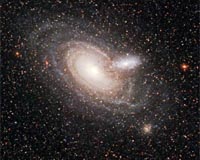
Baltimore MD (SPX) Sep 17, 2008 NASA's Hubble Space Telescope has captured a rare alignment between two spiral galaxies. The outer rim of a small, foreground galaxy is silhouetted in front of a larger background galaxy. Skeletal tentacles of dust can be seen extending beyond the small galaxy's disk of starlight. Such outer dark dusty structures, which appear to be devoid of stars, like barren branches, are rarely so visible in a galaxy because there is usually nothing behind them to illuminate them. Astronomers have never seen dust this far beyond the visible edge of a galaxy. They do not know if these dusty structures are common features in galaxies. Understanding a galaxy's color and how dust affects and dims that color are crucial to measuring a galaxy's true brightness. By knowing the true brightness, astronomers can calculate the galaxy's distance from Earth. Astronomers calculated that the background galaxy is 780 million light-years away. They have not as yet calculated the distance between the two galaxies, although they think the two are relatively close, but not close enough to interact. The background galaxy is about the size of the Milky Way Galaxy and is about 10 times larger than the foreground galaxy. Most of the stars speckled across this image belong to the nearby spiral galaxy NGC 253, which is out of view to the right. Astronomers used Hubble's Advanced Camera for Surveys to snap images of NGC 253 when they spied the two galaxies in the background. From ground-based telescopes, the two galaxies look like a single blob. But the Advanced Camera's sharp "eye" distinguished the blob as two galaxies, cataloged as 2MASX J00482185-2507365. The images were taken on Sept. 19, 2006. The results have been submitted for publication in The Astronomical Journal. Credit: NASA, ESA, The Hubble Heritage Team (STScI/AURA) Acknowledgment: B. Holwerda (Space Telescope Science Institute) and J. Dalcanton (University of Washington) Community Email This Article Comment On This Article Share This Article With Planet Earth
Related Links Hubble Space Telescope Stellar Chemistry, The Universe And All Within It
 1843 Eruption May Be Common In The Universe
 Berkeley CA (SPX) Sep 11, 2008
Eta Carinae, the galaxy's biggest, brightest and perhaps most studied star after the sun, has been keeping a secret: Its giant outbursts appear to be driven by an entirely new type of stellar explosion that is fainter than a typical supernova and does not destroy the star. |
|
|

| The content herein, unless otherwise known to be public domain, are Copyright 1995-2007 - SpaceDaily.AFP and UPI Wire Stories are copyright Agence France-Presse and United Press International. ESA Portal Reports are copyright European Space Agency. All NASA sourced material is public domain. Additional copyrights may apply in whole or part to other bona fide parties. Advertising does not imply endorsement,agreement or approval of any opinions, statements or information provided by SpaceDaily on any Web page published or hosted by SpaceDaily. Privacy Statement |
 del.icio.us
 Digg
Digg Reddit
 YahooMyWeb
 Google
 Facebook