|
 |
 |
 |
 |
 |
 |
 |
 |

 |
Galactic Winds Blow Away Idea Of Island Universe
College Park - Nov 24, 2003 It was the 17th Century English preacher and poet John Donne who wrote the immortal lines "No man is an island, entire of itself; every man is a piece of the continent, a part of the main." Today, astronomers have determined we also do not live in an "island Universe" - that is, a Universe in which the vast agglomerations of gas and stars known as galaxies are wholly independent of the influence of neighboring galaxies and their surrounding environment. Sylvain Veilleux, an astronomer at the University of Maryland, and his colleagues have found important new evidence to support the connectedness of galaxies in the form of unexpectedly large-scale "galactic winds" blowing off of galaxies, altering their surroundings out to distances much farther than previously thought. Galactic winds are the streams of charged particles that blow off of galaxies. "We are seeing that these galactic winds are blowing off of galaxies on a very large scale," said Veilleux. "We have detected these winds in both visible light and X-ray light on scales that are sometimes much larger than the galaxies themselves." The findings are published in the November 2003 issue of the Astronomical Journal, Vol. 126 No. 5. Veilleux's colleagues in this study were David S. Rupke, a graduate student in physics at the University of Maryland, Patrick L. Shopbell of the California Institute of Technology, Jonathan Bland-Hawthorn of the Anglo-Australian Observatory in Australia, and Gerald N. Cecil of the University of North Carolina at Chapel Hill. Based on data from the Chandra X-ray Observatory, the Anglo-Australian Observatory located near Coonabarabran in Australia, and the William Herschel Telescope on La Palma in the Canary Islands, Veilleux said these findings have important consequences for the evolution of galaxies and their environment. Veilleux and his colleagues examined the galactic winds surrounding 10 galaxies. Located between 20 and 900 million light years from Earth, the galaxies are in different galaxy clusters and none are in our Milky Way Galaxy's Local Group cluster. But Veilleux, who is presently on sabbatical at the California Institute of Technology, believes the findings hold for the Milky Way's galactic wind as well. Galactic winds result from two sources: stars and actively feeding (accreting) giant black holes lurking at the centers of most galaxies. In the first case, Veilleux said, the winds are primarily produced by a combination of the stellar winds blowing off massive stars during their youth and by the titanic explosions known as supernovae that mark their death. Winds produced by these stars are referred to as "starburst-driven." Starbursts are periods during which large numbers of massive stars are created. These, periods of star creation, in turn, produce strong stellar winds. These massive stars eventually die as supernova. In the second case, he said, enormous (supermassive) and active black holes lurking in the hearts of their host galaxies generate galactic winds. "An 'active' black hole is one that is accreting or pulling in a significant amount of the material that is available to it," Veilleux said. "Such black holes are called 'active galactic nuclei' or AGN and the winds they produce are referred to as AGN-driven." The Milky Way's central black hole is an inactive or dormant black hole simply because there isn't much material in its vicinity available for it to accrete.
Measuring the Galactic Wind "We can detect these galactic winds because collisions among the charged particles create electromagnetic energy emissions in the form of X rays, visible light and radio waves," he explained. "These emissions are not uniform in the regions around the galaxies. Rather, they are clumpy, being most notable in the regions where hot gas in the wind collides with colder material from the galaxies themselves or from the intergalactic medium." The result is filaments of emissions surrounding galaxies in irregular bubble-shaped regions out to at least 65,000 light years from the galaxy centers. Veilleux and his colleagues compared existing Chandra X-ray data with new ground-based observations obtained with a special tunable filter on the Anglo-Australian telescope, which permitted the detection of optical emission down to unprecedented brightness levels. They found the clumpy filaments correlated quite well. This, they say, indicates that galactic winds are indeed influencing the surrounding inter-galactic environment out to previously unknown distances.
A Role in the Evolution Galaxies? Veilleux said the findings mean any comprehensive understanding of long-term galaxy evolution must take into account the flow of gaseous material out of, and back into, the galaxy. "Galactic winds move at between about 300 and 3000 kilometers per second and if they don't have enough speed to escape the gravitational pull of the galaxy entirely, it means the material in them would rain back down on the galactic halo and even the disk," he said. Veilleux explained that such a return "rain" would contribute to the re-enrichment of the host galaxy itself and in this way the more massive galaxies would be able to keep their heavier metals (the sort forged by massive stars during their lives and deaths in supernovae). "The whole issue of the flow of warm gas back into galaxies is very important to understanding the rate at which new stars form." As for the implications to the Milky Way, Veilleux said the findings for these far away galaxies suggest our Galaxy has its own galactic wind that is creating large-scale bubbles of material around it. Previous findings for the Milky Way have shown direct evidence for a galactic-scale wind at a variety of wavelengths. It is unclear if the Milky Way's wind is interacting with the nearby Sagittarius dwarf galaxy, which astronomers have discovered is being assimilated into our galaxy through tidal (gravitational) forces. However, Veilleux's findings have established that galaxies do indeed interact with their surroundings in important ways. "As a result of findings such as these, we now know the closed box or 'island Universe' view is not true," he said. Community Email This Article Comment On This Article Related Links Sylvain Veilleux at Maryland SpaceDaily Search SpaceDaily Subscribe To SpaceDaily Express Nuclear Space Technology at Space-Travel.com
 JHU-STScI Team Maps Dark Matter In Startling Detail
 Baltimore MD (SPX) Dec 12, 2005
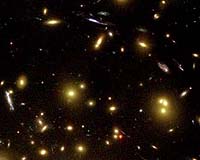
Clues revealed by the recently sharpened view of the Hubble Space Telescope have allowed astronomers to map the location of invisible "dark matter" in unprecedented detail in two very young galaxy clusters. |
|
|

| The content herein, unless otherwise known to be public domain, are Copyright 1995-2006 - SpaceDaily.AFP and UPI Wire Stories are copyright Agence France-Presse and United Press International. ESA PortalReports are copyright European Space Agency. All NASA sourced material is public domain. Additionalcopyrights may apply in whole or part to other bona fide parties. Advertising does not imply endorsement,agreement or approval of any opinions, statements or information provided by SpaceDaily on any Web page published or hosted by SpaceDaily. Privacy Statement |