|
 |
 |
 |
 |
 |
 |
 |
 |

 |
GLAST Team Working Toward 2007 Launch
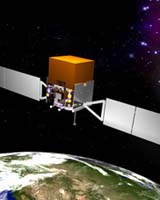
Greenbelt MD (SPX) May 18, 2006 NASA scientists and engineers have completed assembly of the primary instrument for the Gamma-ray Large Area Space Telescope, an orbiting observatory scheduled to launch from Kennedy Space Center in the fall of 2007. Unlike visible light, gamma rays are too energetic to be focused by traditional telescope mirrors onto a detector. So, GLAST's main instrument, the Large Area Telescope, will employ detectors that convert incoming gamma rays into electrons and their antimatter partners, called positrons. This technique � changing light into matter as described by Einstein's equation E=mc^2 - is called pair conversion. It will enable scientists to track the direction of gamma rays and measure their energy. GLAST's key observation targets will include powerful particle jets emanating from supermassive black holes - and possibly even the theorized collisions of dark matter particles. The Large Area Telescope will be at least 30 times more sensitive than previous gamma-ray detectors and will have a far greater field of view. The telescope arrived on May 14 at the U.S. Naval Research Laboratory in Washington, D.C., for environmental testing. Next, it will undergo three months of what technicians call �shake and bake� testing, to ensure it will survive the intense vibration and noise during launch and operate properly in space. Technicians also will perform electromagnetic interference tests to ensure telescope operations do not interfere with the spacecraft. When testing is finished at the Naval Research Laboratory, the telescope will be shipped to Arizona, where engineers at General Dynamics C4 Systems will combine it with a second instrument, called the Burst Monitor, onto the spacecraft. "The relative range of light energies that the instrument can detect is thousands of times wider than that of an optical telescope, which captures only a thin slice of the electromagnetic spectrum," said Steven Ritz, a project scientist at NASA's Goddard Space Flight Center. "The observatory provides a huge leap in capabilities in this important energy band, and it opens a wide window for exploration and discovery." Goddard manages the GLAST mission, but the Large Area Telescope was built with significant contributions from NASA, the U.S. Department of Energy and foreign collaborating institutions. Stanford University's Linear Accelerator Center will manage the instrument, with collaborators at Goddard, the University of California, Santa Cruz, the University of Washington, Ohio State University, the NRL, and institutions in France, Italy, Japan and Sweden. NASA's Marshall Space Flight Center in Huntsville, Ala., will manage the Burst Monitor with a collaborator in Germany. General Dynamics C4 Systems is building the spacecraft and is responsible for instrument integration. Community Email This Article Comment On This Article Related Links GLAST Space Technology News - Applications and Research
 Revolutionary Japanese LED makes light work
 Paris (AFP) May 17, 2006
 A trio of Japanese scientists say they have invented an ultraviolet light-emitting diode (LED) that could open the way to a new generation of optical discs with very high data-storage capacity. |
|
|

| The content herein, unless otherwise known to be public domain, are Copyright 1995-2006 - SpaceDaily.AFP and UPI Wire Stories are copyright Agence France-Presse and United Press International. ESA PortalReports are copyright European Space Agency. All NASA sourced material is public domain. Additionalcopyrights may apply in whole or part to other bona fide parties. Advertising does not imply endorsement,agreement or approval of any opinions, statements or information provided by SpaceDaily on any Web page published or hosted by SpaceDaily. Privacy Statement |