|
 |
 |
 |
 |
 |
 |
 |
 |

 |
GIOVE-A Ready To Join Its Soyuz Launcher
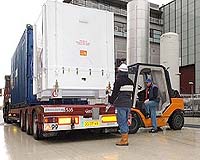
Paris, France (ESA) Dec 27, 2005 With the launch date set for 28 December, work on preparing GIOVE-A for its big day is approaching completion. The satellite and the launcher upper stage that will guide it into its final orbit have now been enclosed in the rocket nose cone. They will soon be moved to the launcher integration facility, where they will be mated with the Soyuz launch vehicle. Following the mating of GIOVE-A and the Fregat upper stage of the launcher, the resulting upper composite has now been enclosed in the fairing, or nose cone, that will protect them as they climb through the first 80 km or so of the Earth's atmosphere. The encapsulated upper composite assembly has been loaded onto a special railway wagon for transport to the MIK 40 building where it will be mated with the Soyuz launcher. After assembly of the payload and launcher, the completed Soyuz will roll out to launch pad number six and be raised into the vertical position, ready for lift off. On launch day, the service tower begins to retract from the launcher thirty minutes before launch. Seven minutes before launch, the Fregat upper stage is initialised and switches over to internal power. One minute later, the launcher is declared "ready to go". Final countdown operations commence at 5m:20s before launch, with the umbilical cables connecting the launcher to the service tower being disconnected at L-2m:35s and the final launch command given at L-2m:05s. Twenty seconds before lift-off, the Soyuz main and booster engines are started. Lift off is scheduled to occur at 06:19:08 CET (05:19 UTC/GMT, 11:19 Baikonur local time). Eight seconds after lift-off, the Soyuz ceases its vertical climb and turns towards the east. Just before two minutes of the flight have elapsed, the four boosters around the base of the Soyuz separate; the second stage, the core of the Soyuz, continues propelling GIOVE on its way towards orbit. At 4m:13s into the flight, the fairing is jettisoned, its protection no longer required in the thin, upper reaches of the atmosphere. Thity-three seconds later, the third Soyuz stage ignites and, just one second after ignition, second stage separation occurs. The thrust of the third stage engine is used to push the second stage away. Soyuz completes its task 8m:49s after lift-off. Fregat and GIOVE, now at an altitude of around 190 km and travelling at 7751 metres per second (nearly 30 000 km per hour) leave the third stage of the launcher behind. Five seconds after separation, Fregat fires its own engine for the first time, starting a burn that will last for just ten seconds. After the first engine burn, GIOVE and Fregat fly on a ballistic trajectory until 38m25s after launch, when a second Fregat engine burn is scheduled. No feedback from the spacecraft is possible at this time, because they are over the Pacific Ocean, about one third of the way from New Zealand to Chile, and out of sight of the ground station network for 1h:32m. Fregat is designed to act autonomously in these circumstances, enabling it to fly complex mission profiles without intervention from its ground controllers. Fregat's second engine burn lasts 9m:56s and moves it and GIOVE from their ballistic coast into a transfer orbit that will take them up to GIOVE's final orbit, 23 222 km above the Earth. Only after a wait of two hours from the time of lift-off will telemetry be received from Fregat about the status of the second engine burn. Real-time information about the status of the spacecraft is available again, a relief to the controllers on the ground. At 3h:35m:59s into the flight, Fregat burns its engine for 4m:01s to inject GIOVE into its final, circular orbit. Two and a half minutes after Fregat engine shut-off, at 3h:42m:31s after launch (10:01:31 CET), GIOVE separates from Fregat and is ready to begin its early orbit operations, with control being transferred to Surrey Satellite System's operations centre in Guildford, UK. GIOVE will go on to deploy its solar arrays and activate the attitude and orbit control system that will keep it pointed in the correct direction during its two year mission. Fregat will burn its engine twice more, to distance itself from GIOVE and prepare for de-orbiting. Community Email This Article Comment On This Article Related Links Galileo Joint Undertaking SpaceDaily Search SpaceDaily Subscribe To SpaceDaily Express GPS Applications, Technology and Suppliers
 SiRFstarIII Featured in TomToms Innovative Portable Navigation Product
 San Jose CA (SPX) Jan 04, 2006
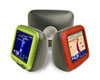
Continuing to drive GPS further into the mainstream market, SiRF Technology Holdings has revealed that its flagship SiRFstarIII GPS technology is at the heart of TomTom's RIDER, a high performance portable navigation system specifically designed for use on motorcycles and scooters. TomTom is a leading provider of personal navigation products and services to the US and European consumer markets. |
|
|

| The content herein, unless otherwise known to be public domain, are Copyright 1995-2006 - SpaceDaily.AFP and UPI Wire Stories are copyright Agence France-Presse and United Press International. ESA PortalReports are copyright European Space Agency. All NASA sourced material is public domain. Additionalcopyrights may apply in whole or part to other bona fide parties. Advertising does not imply endorsement,agreement or approval of any opinions, statements or information provided by SpaceDaily on any Web page published or hosted by SpaceDaily. Privacy Statement |