|
 |
 |
 |
 |
 |
 |
 |
 |

 |
GAO Report Foresees Gap In Weather Satellite Coverage
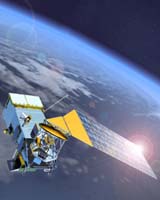
Washington DC (SPX) Apr 2, 2006 A U.S. Government Accountability Office report on a new polar-orbiting environmental satellite program has concluded that cost overruns and procedural difficulties could create a gap in important national weather data derived from the satellites that could last at least three years, beginning in late 2007. The report, undertaken at the request of the Senate Commerce subcommittee on disaster prevention and prediction, found that the program's cost has risen to $10 billion and scheduled launches have been delayed up to three years. These circumstances have triggered the need for what the GAO (formerly the General Accounting Office) report calls "difficult decisions about the program's direction and capabilities." Polar-orbiting environmental satellites provide data and images used by weather forecasters, climatologists and the U.S. military to map and monitor changes in weather, climate, the oceans and the environment. The satellites are critical to long-term weather prediction, including advance forecasts of hurricane paths and intensity. The current U.S. program comprises two satellite systems - one operated by the National Oceanic and Atmospheric Administration, and one by the Department of Defense - as well as supporting ground stations and four central data processing centers. The new program, called the National Polar-orbiting Operational Environmental Satellite System, or NPOESS, is supposed to replace the two systems with a single, state-of-the-art environment-monitoring satellite network. NPOESS - to be managed jointly by NOAA, DOD and NASA - will be critical to maintaining the continual data required for weather-forecasting and global climate monitoring though 2020. The problem is the last NOAA polar-orbiting satellite in the existing program is scheduled to be launched in late 2007, while the first NPOESS launch will not be until at least late 2010. If the earlier satellite fails, its data capability would be difficult, if not impossible, to replace during the interim. Meanwhile, NPOESS's future direction � what will be delivered, at what cost, and by when � remains on hold pending a decision about how to proceed, the GAO report said. The NPOESS executive committee had been expected to make several critical decisions by the end of last year, but in late November, the program's cost growth exceeded a legislatively mandated threshold, which required DOD to certify the need for NPOESS to Congress. The situation placed any decision about future direction on hold until certification is completed, now scheduled for June. Until then, NPOESS officials have decided to continue work on key sensors and other program elements using fiscal year 2006 funding. Following DOD certification, the report said, "A decision on future direction should be clear." Proceeding will require a new program baseline and renegotiated contracts � efforts that could take up to a year. GAO has advised the three sponsoring agencies to collaborate on important policy considerations, and warned about the impact of further delays on satellite coverage. "Once program direction is decided," the report said, "it will be important to move quickly to adjust agency budgets and contracts," adding that continuing oversight of program and executive management "is essential to avoid repeating past problems." Community Email This Article Comment On This Article Related Links FULL GAO REPORT - PDF File NPOESS POESS DMSP NOAA Weather News at TerraDaily.com
 Devices Give Weather At-A-Glance
 Washington (UPI) Mar 31, 2006
A variety of new ' novel devices are changing the way consumers get their weather -- including such techno items as a weather-forecasting umbrella. The fusion of various objects' technology has sparked much consumer interest by providing the simplest of practical convergent devices. |
|
|

| The content herein, unless otherwise known to be public domain, are Copyright 1995-2006 - SpaceDaily.AFP and UPI Wire Stories are copyright Agence France-Presse and United Press International. ESA PortalReports are copyright European Space Agency. All NASA sourced material is public domain. Additionalcopyrights may apply in whole or part to other bona fide parties. Advertising does not imply endorsement,agreement or approval of any opinions, statements or information provided by SpaceDaily on any Web page published or hosted by SpaceDaily. Privacy Statement |