|
 |
 |
 |
 |
 |
 |
 |
 |

 |
Futuristic Design Wins Competition For New Antarctic Research Station
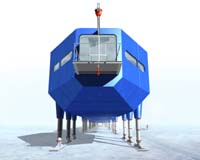
(SPX) Jul 20, 2005 A futuristic design by Faber Maunsell and Hugh Broughton Architects has won the competition for the new British Antarctic Survey (BAS) Halley Research Station. In a very close-run contest, three finalists presented their ideas to a Jury Panel, technical advisory panel and BAS scientists. Director of BAS, Professor Chris Rapley, CBE said, 'This was an incredibly tough choice for the Jury Panel to make. We were presented with three outstanding schemes - each one of them creating an exceptional solution for living and working in this extreme environment. Of course, only one scheme can go through to construction. In my view each team is a winner and I really hope that the runners-up realise how much we value their ideas. This competition was launched to bring innovation and creativity to the challenge of building a scientific research station on a floating ice shelf. The process, which involved a working partnership between each design team and the BAS technical teams, was stimulating and exciting for everyone involved. I extend my warm congratulations to Faber Maunsell and Hugh Broughton Architects on their success at winning this competition.' The new modular station, elevated on ski-based jackable legs to avoid burial by snow, can be towed across the ice. The modules are simple to construct and can be re-arranged or relocated inland periodically as the ice shelf flows towards the sea. A central module packed with stimulating areas for recreation and relaxation is flanked by a series of modules designed to suit the changing needs of the science programmes. It features renewable energy sources and new environmental strategies for fuel, waste and material handling. Community Email This Article Comment On This Article Related Links Halley VI at BAS British Antarctic Survey SpaceDaily Search SpaceDaily Subscribe To SpaceDaily Express Nuclear Space Technology at Space-Travel.com
 Rewriting Glacial History In Pacific North America
 Edmonton AB (SPX) Jan 10, 2006
Although the story on glacier fluctuations in northwestern North America over the last 10,000 years has remained largely unchanged for decades, new evidence discovered by a University of Alberta researcher will rewrite that glacial history and offer clues about our climate history during the last several thousand years. |
|
|

| The content herein, unless otherwise known to be public domain, are Copyright 1995-2006 - SpaceDaily.AFP and UPI Wire Stories are copyright Agence France-Presse and United Press International. ESA PortalReports are copyright European Space Agency. All NASA sourced material is public domain. Additionalcopyrights may apply in whole or part to other bona fide parties. Advertising does not imply endorsement,agreement or approval of any opinions, statements or information provided by SpaceDaily on any Web page published or hosted by SpaceDaily. Privacy Statement |