Energy News  
From The Mojave To The Moon: Neil Armstrong's Early NASA Years

lunar reflections

Edwards CA (SPX) Jul 19, 2004
The B-29 mothership shuddered, and Neil Armstrong, flying the airplane from the co-pilot's seat, glimpsed a bullet-shaped propeller hub shoot past the cockpit. He looked over and saw that the number four propeller had disintegrated.

Armstrong, along with pilot Stan Butchart, reacted coolly, testing the bomber's controls. Butchart's were gone, but Armstrong still had some flight control linkage, so together they prepared the aircraft for an emergency landing. They had been trying unsuccessfully for some time to feather the number four propeller.

Seconds before the disintegration, they had jettisoned the D-558-II Skyrocket research craft with pilot Jack McKay aboard to land early, due to a stuck valve on the Skyrocket, as well as the large workload the propeller problem presented. McKay landed the Skyrocket safely on the dry lakebed below.

This hair-raising moment in 1956 over California's Mojave Desert, and others experienced later in space, footnote the illustrious career of Neil Armstrong, the first man to walk on the moon.

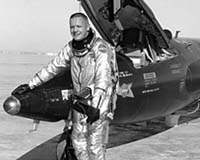
Before joining NASA's astronaut corps, Armstrong served as a research pilot at the NASA High Speed Flight Station, now NASA's Dryden Flight Research Center, located on Edwards Air Force Base in Calif., from 1955-1962.

The first airplane Armstrong flew at NASA Dryden was a World War II-vintage P-51 Mustang fighter. He learned the ropes of airborne data collection in this aircraft, performing many flights to hone his techniques. Early on, flying the station's modified B-29 mothership aircraft, he launched more than 100 X-plane missions.


Community
Email This Article
Comment On This Article

Related Links
SpaceDaily
Search SpaceDaily
Subscribe To SpaceDaily Express
Stellar Chemistry, The Universe And All Within It


Memory Foam Mattress Review
Newsletters :: SpaceDaily :: SpaceWar :: TerraDaily :: Energy Daily
XML Feeds :: Space News :: Earth News :: War News :: Solar Energy News


Sloan Survey Identifies New Dwarf Galaxy Inside Milky Way
Washington DC (SPX) Jan 10, 2006
Astronomers using the Sloan Digital Sky Survey have discovered a previously unknown cluster of stars within the Milky Way that appears to be a separate dwarf galaxy being consumed by its much larger neighbor.


  • Invention Found To Grow Superconducting And Magnetic Nanocables
  • General Dynamics Completes Acquisition of Spectrum Astro
  • Chinese Power Plant Will Exceed Plans
  • Areva Upgrades US Nuclear Power Plants With New Cutting Edge Technology

  • Yucca Mountain Site Must Make Use Of Geological Safety Net
  • New Jersey Physicist Uncovers New Information About Plutonium
  • Complex Plant Design Goes Virtual To Save Time And Money
  • Volcanic Hazard At Yucca Mountain Greater Than Previously Thought


  • NASA Uses Remotely Piloted Airplane To Monitor Grapes


  • NASA To Award Contract For Aerospace Testing
  • Sonic Boom Modification May Lead To New Era
  • Hewitt Pledges Support For Aerospace Industry
  • National Consortium Picks Aviation Technology Test Site

  • NASA plans to send new robot to Jupiter
  • Los Alamos Hopes To Lead New Era Of Nuclear Space Tranportion With Jovian Mission
  • Boeing Selects Leader for Nuclear Space Systems Program
  • Boeing-Led Team to Study Nuclear-Powered Space Systems

  • The content herein, unless otherwise known to be public domain, are Copyright 1995-2006 - SpaceDaily.AFP and UPI Wire Stories are copyright Agence France-Presse and United Press International. ESA PortalReports are copyright European Space Agency. All NASA sourced material is public domain. Additionalcopyrights may apply in whole or part to other bona fide parties. Advertising does not imply endorsement,agreement or approval of any opinions, statements or information provided by SpaceDaily on any Web page published or hosted by SpaceDaily. Privacy Statement