|
 |
 |
 |
 |
 |
 |
 |
 |

 |
From Shuttle To Orion At Stennis
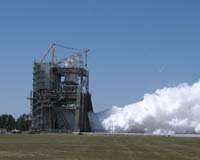
Stennis MS (SPX) Oct 03, 2006 NASA is marking a historic moment in the life of the nation's largest rocket engine test complex. The Stennis Space Center conducted the final space shuttle main engine test on its A-1 Test Stand on Friday, Sept. 29. Although this ends the stand's work on the Space Shuttle Program, it will soon be used for the rocket that will carry America's next generation human spacecraft, Orion. The A-1 Test Stand was the site of the first test on a shuttle main engine in 1975. Stennis will continue testing shuttle main engines on its A-2 Test Stand through the end of the Space Shuttle Program in 2010. The A-1 stand begins a new chapter in its operational history in October. It will be temporarily decommissioned to convert it for testing the J-2X engine, which will power the upper stage of NASA's new crew launch vehicle, the Ares I. The J-2X will also power the Earth departure stage of the Ares V new cargo launch vehicle. The Ares I and V vehicles will provide the thrust, while the Orion crew capsule will be future astronauts' home in space. The J-2X is a modification of the Apollo Program's J-2 engine, which helped send the first Americans to the moon. The original J-2s were also tested at Stennis. Community Email This Article Comment On This Article Related Links Ares Launch Vehicles Stennis Space Center Rocket Science News at Space-Travel.Com Rocket Science News at Space-Travel.Com
 ATK Completes Milestone Test In Development Program For The Ares I CLV
 Promontory UT (SPX) Oct 03, 2006
NASA's next-generation crew launch vehicle may be years away from flying its first astronauts to space, but Alliant Techsystems is already completing tests and building hardware to ensure that Ares I will fly on schedule. ATK -- the prime contractor for the first stage of the Ares I crew launch vehicle, along with NASA, the US Army, and the United Space Alliance -- recently completed testing of a newly designed pilot parachute. |
|
|

| The content herein, unless otherwise known to be public domain, are Copyright 1995-2006 - SpaceDaily.AFP and UPI Wire Stories are copyright Agence France-Presse and United Press International. ESA PortalReports are copyright European Space Agency. All NASA sourced material is public domain. Additionalcopyrights may apply in whole or part to other bona fide parties. Advertising does not imply endorsement,agreement or approval of any opinions, statements or information provided by SpaceDaily on any Web page published or hosted by SpaceDaily. Privacy Statement |