|
 |
 |
 |
 |
 |
 |
 |
 |

 |
Fresh Light Cast On Sandstorm Origins
Beijing (XNA) May 22, 2006 A 10-year study on sandstorms has cast new light on the origins and movements of the dusty phenomenon. The storms are closely related to Siberian cold fronts, and come along three different routes, said Kang Ling, deputy director of the Observatory of the Inner Mongolia Autonomous Region. In the eastern route, the front runs southward through central and eastern Mongolia, affecting Northeast China, central and eastern Inner Mongolia, Shanxi and Hebei provinces. The central route is southward through central and western Mongolia, affecting central and western Inner Mongolia and eastern areas of Northwest China, central and southern parts of North China. To the west, the front blows southward through western Mongolia and northeast Kazakhstan, affecting western parts of China, and areas of North China. "Most of the sandstorms sweeping Beijing and Tianjin this year came from abroad and mainly through the central route," Kang said in a Xinhua report. Statistics indicated that at least 11 major sandstorms hit North China during the past two months, making it "the worst sandstorm weather in the spring season for a decade." What's worse, meteorologists predicted more storms later this month. Researchers from the China Meteorological Administration, Kang's observatory and the China-Japan Friendship Centre for Environmental Protection participated in the research programme. Satellites, remote sensing, radar and other high technologies were used to study the source regions, routes and the influence on Beijing.. Kang said some of the sandstorms originated in China and others came from abroad. "Desert is the major source of sandstorms," said Zhang Xiaoye, head of the Chinese Academy of Meteorological Sciences. "Sandstorms will not disappear until the deserts totally vanish." Statistics indicate that China has 1.67 million square kilometres of desert. Traditional farming methods in northern parts of the country also have an influence, experts said. "The dry and vulnerable topsoil in North China can easily be picked up and carried by the wind," said Jin Heling, an expert with the Institute of Environment and Engineering in Cold and Arid Regions under the Chinese Academy of Sciences. "Sandstorms are usually triggered by sudden temperature changes in springtime, poor vegetation cover and aridity. However, exposed plough land where soil can be blown away is also a major cause," said Kang. Meteorologists suggested that a protective forest be established around Beijing and Tianjin and more trees be planted in Inner Mongolia to curb desertification. Since the late 1990s, the Chinese Government has invested heavily in the implementation of the Sandstorm Source Control Project in and around Beijing and Tianjin. To date, the government has invested 55.8 billion yuan (US$6.9 billion) in various projects, including tree planting. One-fourth of the programme has been finished and one-seventh of exposed land made green.
Source: Xinhua News Agency Community Email This Article Comment On This Article Related Links Subscribe to SinoDaily Express - your China News Source Weather News at TerraDaily.com
 NOAA Weather Satellite Launch Set For Wednesday
 Cape Canaveral Air Force Station FL (SPX) May 21, 2006
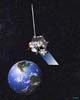
NASA has announced it will launch NOAA's Geostationary Operational Environmental Satellite-N on Wednesday, May 24. GOES-N, designed to provide faster environmental and weather information to meteorologists and the public, is scheduled to lift off from Launch Complex 37 at Cape Canaveral Air Force Station. |
|
|

| The content herein, unless otherwise known to be public domain, are Copyright 1995-2006 - SpaceDaily.AFP and UPI Wire Stories are copyright Agence France-Presse and United Press International. ESA PortalReports are copyright European Space Agency. All NASA sourced material is public domain. Additionalcopyrights may apply in whole or part to other bona fide parties. Advertising does not imply endorsement,agreement or approval of any opinions, statements or information provided by SpaceDaily on any Web page published or hosted by SpaceDaily. Privacy Statement |