|
 |
 |
 |
 |
 |
 |
 |
 |

 |
French Spaceship Begins Search For New Planets
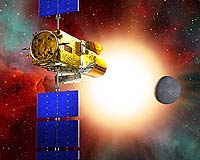
Moscow (AFP) Dec 27, 2006 A French-made spacecraft began its two-and-a-half year search for undiscovered planets suitable for human habitation outside our solar system on Wednesday, scientists said. The satellite, known by the acronym COROT, was successfully put into its circular polar orbit by a Russian rocket after blasting off from Kazakhstan at 8:23 pm (1423 GMT), Euro-Russian space agency Starsem said. COROT is a cooperation between France's national space research centre CNES -- which is assuming the lion's share of the 170 million euros (225 million dollars) cost -- the European Space Agency (ESA), Brazil, Germany, Austria and Belgium. Armed with a 30-centimetre (12-inch) telescope and two cameras, COROT (Convection Rotation and planetary Transits) will seek out new planets, possibly confirming the existence of rocky celestial bodies with physical properties comparable to the solar system's own planets. It is also designed to study the vibratory performance of stars to determine their internal structure, age and composition. In the past decade scientists have detected around 190 exoplanets -- planets outside our solar system orbiting stars -- from Earth. By monitoring some 120,000 stars, the closest 40 light years from Earth, COROT promises to find many more. Many of the planets COROT will detect are expected to be so-called "hot Jupiters" or gaseous worlds. But an unknown percentage are expected to be rocky planets, maybe just a few times larger than the Earth, or perhaps even smaller. If COROT finds such planets, they will constitute a new class of planet altogether, the ESA said. COROT will also be able to detect starquakes -- acoustic waves generated deep inside a star that send ripples across its surface, altering its brightness. The exact nature of the ripples allows astronomers to calculate the star's precise mass, age and chemical composition. Following COROT will be Kepler, a much larger scale planet-finding probe from the US space agency NASA, due for launch in October 2008, but COROT will perform valuable groundwork, its backers say. "COROT is a small project put together with small means, but it is the scout that will show to future missions what kind of star to go look for," said the scientific head of the mission, Annie Baglin.
Source: Agence France-Presse Community Email This Article Comment On This Article Related Links CNES Beyond Sol Lands Beyond Beyond - extra solar planets - news and science Life Beyond Earth
 Metal Ring Round White Dwarf Solves Missing Planets Puzzle
 Warwick UK (SPX) Dec 27, 2006
Astrophysicists at the University of Warwick have found an unusual ring of metal-rich gas orbiting very close around a white dwarf star. The presence of the ring helps solve a problem for astronomers who, up till now, have been puzzled by the apparent absence of planets around white dwarf stars. Their research is published today in the Friday December 22nd edition of the journal Science. Click on the picture above for a print quality high resolution artist's impression of the White Dwarf and its ring. |
|
|

| The content herein, unless otherwise known to be public domain, are Copyright 1995-2006 - SpaceDaily.AFP and UPI Wire Stories are copyright Agence France-Presse and United Press International. ESA PortalReports are copyright European Space Agency. All NASA sourced material is public domain. Additionalcopyrights may apply in whole or part to other bona fide parties. Advertising does not imply endorsement,agreement or approval of any opinions, statements or information provided by SpaceDaily on any Web page published or hosted by SpaceDaily. Privacy Statement |