|
 |
 |
 |
 |
 |
 |
 |
 |

 |
Free Electron Laser Reaches 10 KW
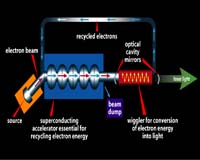
Newport News VA (SPX) Aug 02, 2004 The Free-Electron Laser (FEL), supported by the Office of Naval Research and located at the U.S. Department of Energy's Thomas Jefferson National Accelerator Facility, achieved 10 kilowatts of infrared laser light in late July, making it the most powerful tunable laser in the world. The recently upgraded laser's new capabilities will enhance defense and manufacturing technologies, and support advanced studies of chemistry, physics, biology, and more. "No other laser can provide the same benefits to manufacturing, medical research, biology, and basic physics," said ONR's Directed Energy Program Officer, Mr. Quentin Saulter. "The Navy has chosen the FEL because it has multi-mission capabilities. Its unique, high-power and 24-hour capabilities are ideal for Department of Defense, industrial, and scientific applications." The FEL program began as the One-Kilowatt Demonstration FEL, which broke power records and made its mark as the world's brightest high average power laser. It delivered 2.1 kilowatts (kW) of infrared light, more than twice it was initially designed to achieve, before it was taken offline in November 2001 for an upgrade to 10 kW. "Whenever a technology gains a factor of ten improvement in performance, the achievement opens the door to many new applications, some foreseen, and some are simply very pleasant surprises," said Christoph Leemann, Jefferson Lab Director. "We look forward to operating this exciting new machine and carrying out the many experiments planned for it." The FEL provides intense beams of laser light that can be tuned to a precise wavelength, and which are more powerful than beams from a conventional laser. Conventional lasers are limited in the wavelength of light they emit by the source of the electrons (such as a gas or crystal) used within the laser. In the FEL, electrons are stripped from their atoms and then whipped up to high energies by a linear accelerator. From there, they are steered into a wiggler-a device that uses an electromagnetic field to shake the electrons, forcing them to release some of their energy in the form of photons. As in a conventional laser, the photons are bounced between two mirrors and then emitted as a coherent beam of light. However, FEL operators can adjust the wavelength of the laser's emitted light by increasing or decreasing the energies of the electrons in the accelerator or the amount of shaking in the wiggler. "As we cross the 10 kW milestone, our team at Jefferson Lab is grateful for the considerable support and encouragement we have received from the Navy, Air Force and our colleagues across the country," said Fred Dylla, Jefferson Lab FEL program manager. ONR's Quentin Saulter manages the FEL development effort in cooperation with the Naval Sea Systems Command (NAVSEA) Directed Energy and Electric Weapons Office, headed by Captain Roger McGinnis. ONR is also funding the operation and optimization of the 10 kW FEL, and has several experiments slated to begin in early fall. A laser materials damage study will be co-funded with the Office of the Secretary of Defense High Energy Laser Joint Technology Office (HEL-JTO). In another project, scientists from the Naval Research Laboratory will study laser propagation through the atmosphere, with an eye to new laser-based shipboard defense strategies. The Navy is also interested in the ultraviolet and terahertz light that the FEL can produce at world-record powers. The Navy intends on using the lessons learned from the development of the 10 kW FEL to begin design and construction of a 100 kW FEL over the next four years. Eventually, the Navy plans on moving the 100 kW laser to an over water test site, and scaling the power up to megawatt levels. Community Email This Article Comment On This Article Related Links Free-Electron Laser SpaceDaily Search SpaceDaily Subscribe To SpaceDaily Express Space Technology News - Applications and Research
 LIGO Up And Running, But Gravity Waves Remain Elusive
 Washington DC (SPX) Jan 10, 2006
Scientists working on the Laser Interferometer Gravitational-Wave Observatory said Monday the facility has reached its target detection sensitivity, but the goal of finding the elusive phenomena known as gravity waves remains as elusive as ever. |
|
|

| The content herein, unless otherwise known to be public domain, are Copyright 1995-2006 - SpaceDaily.AFP and UPI Wire Stories are copyright Agence France-Presse and United Press International. ESA PortalReports are copyright European Space Agency. All NASA sourced material is public domain. Additionalcopyrights may apply in whole or part to other bona fide parties. Advertising does not imply endorsement,agreement or approval of any opinions, statements or information provided by SpaceDaily on any Web page published or hosted by SpaceDaily. Privacy Statement |