|
 |
 |
 |
 |
 |
 |
 |
 |

 |
Fractal-Shaped Tiles Developed For New Broadband Class Antenna
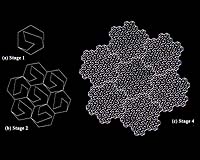
University Park - Oct 29, 2003 Penn State engineers have developed innovative design methods for a new class of antennas composed of an array of fractal-shaped tiles that offer anywhere from a 4:1 to 8:1 improvement in bandwidth compared to their conventional counterparts. Many natural objects, such as tree branches and their root systems, peaks and valleys in a landscape and rivers and their tributaries are versions of mathematical fractals which appear pleasingly irregular to the eye but are actually made of self-similar, repeated units. The new broadband antennas are composed of irregular but self-similar, repeated fractal-shaped unit tiles or "fractiles" which cover an entire plane without any gaps or overlaps. The outer boundary contour of an array built of fractiles follows a fractal distribution. Dr. Douglas H. Werner, professor of electrical engineering and senior scientist in Penn State's Applied Research Laboratory, will describe the new antennas and their generation at the 2003 IEEE AP-S Topical Conference on Wireless Communication Technology, Oct. 16, in Honolulu, Hawaii. His paper is "A New Design Methodology for Modular Broadband Arrays Based on Fractal Tilings." His co-authors are Waroth Kuhirun, graduate student, and Dr. Pingjuan Werner, associate professor of electrical engineering. While fractal concepts have been used previously in antenna design, Werner and his research team are the first to introduce a design approach for broadband phased array antenna systems that combines aspects of tiling theory with fractal geometry. Once the specific fractile array has been designed, the Penn State team exploits the fact that fractal arrays are generated recursively or via successive stages of growth starting from a simple initial unit, to develop fast recursive algorithms for calculating radiation patterns. Using the recursive property, they have also developed rapid algorithms for adaptive beam forming, especially for arrays with multiple stages of growth that contain a relatively large number of elements. Werner says, "The availability of fast beam forming algorithms is especially advantageous for designing smart antenna systems." The Penn State team has also shown that a fractile array made of unit tiles based on the Peano-Gosper curve, for example, offers performance advantages over a similar-sized array with conventional square boundaries. The Peano-Gosper fractile array produces no grating lobes over a much wider frequency band than conventional periodic planar square arrays. Werner explains that "Grating lobes are sidelobes with the same intensity as the mainbeam. They are undesirable because they take energy away from the main beam and focus it in unintended directions, causing a reduction in the gain of an antenna array." The University is patenting the team's approach to Peano-Gosper and related fractile arrays. The team has also been awarded a grant through the Applied Research Laboratory to build and test a prototype. Community Email This Article Comment On This Article Related Links Penn State University SpaceDaily Search SpaceDaily Subscribe To SpaceDaily Express Space Technology News - Applications and Research
 Industry Team Achieve New Communications Technology With AESA Radars
 Baltimore MD (SPX) Jan 12, 2006
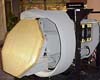
A team comprised of three leading US aerospace and defense contractors has demonstrated an innovative technological use of active electronically scanned array (AESA) radars for high-bandwidth communications. |
|
|

| The content herein, unless otherwise known to be public domain, are Copyright 1995-2006 - SpaceDaily.AFP and UPI Wire Stories are copyright Agence France-Presse and United Press International. ESA PortalReports are copyright European Space Agency. All NASA sourced material is public domain. Additionalcopyrights may apply in whole or part to other bona fide parties. Advertising does not imply endorsement,agreement or approval of any opinions, statements or information provided by SpaceDaily on any Web page published or hosted by SpaceDaily. Privacy Statement |