|
 |
 |
 |
 |
 |
 |
 |
 |

 |
Fossils Reveal Effects Of Global Warming
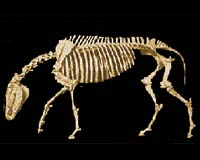
Denver - Feb 19, 2003 How will global warming affect life on Earth? Uncertainties about future climate change and the impact of human activity make it difficult to predict exactly what lies ahead. But the past offers clues, say scientists who are studying a period of warming that occurred about 55 million years ago. In a joint project of the University of Michigan, the University of New Hampshire and the Smithsonian Institution, researchers have been analyzing fossils from the badlands of Wyoming found in a distinctive layer of bright red sedimentary rock that was deposited at the boundary between the Paleocene and Eocene epochs -- a time of apparent sudden climate change. The researchers described their findings in a paper presented Feb. 16 at the annual meeting of the American Association for the Advancement of Science. "The interval of Earth history that we're studying is marked by a short-term global warming event thought to have occurred when something triggered the release of methane from methane clathrate -- a kind of 'methane ice' found in ocean sediments," said Philip D. Gingerich, professor of geological sciences at the University of Michigan. Within about 10,000 years of peak warming, mammals such as primates and the groups that include horses and deer appeared together for the first time in North America, apparently having crossed land bridges from other continents. As the warm spell continued, the animals showed an intriguing response: they became smaller. For example, "horses from this period that had been the size of a small dog were reduced to the size of a Siamese cat," Gingerich said. When the climate returned to normal, the animals became normal size again. To understand why dwarf versions of the various animals appeared and then disappeared from the fossil record, Gingerich turned to colleagues at the University of Michigan Biological Station who are studying the effects of elevated carbon dioxide levels -- associated with global warming -- on plant growth. "They find that if you grow plants in a carbon dioxide-rich atmosphere, the plants love it. They grow fast. It's easy for them." But in the process, the plants incorporate less protein and more defensive compounds than they normally would. Insects that eat these plants grow more slowly, and the same might be true of mammals, Gingerich reasoned. Furthermore, "the reproductive cycles of mammals that live in seasonal environments are tuned to seasonal cycles," Gingerich said. "If an animal has a one- or two-year period in which to grow to maturity and reproduce, and it's trying to do that on a diet that's difficult to digest and not very nutritious, it's not surprising that it would evolve to be smaller. "And it's also not surprising that when times are good again and carbon dioxide levels are lower and plants grow like they normally should, that the animals would go back to what we think of as their normal size." It's not clear whether the body size trends represent true evolutionary change or whether the larger species were simply replaced by smaller sister species, but Gingerich hopes to answer that question as he continues to work on the project. He and his coworkers, William C. Clyde of the University of New Hampshire and Scott L. Wing and Guy J. Harrington of the Smithsonian Institution, also hope their work will improve understanding of climate change in general. "This is a model of an event in the past that involved change and recovery from change," Gingerich said. "During that 80,000-year period, mammals didn't go extinct; they adapted through dwarfing. And eventually, the system worked itself back to the previous state." But just because Earth and its inhabitants recovered from global warming in the past don't assume we have nothing to worry about now, Gingerich cautions. "In today's Earth, additional warming could set off a methane release that would bump the Earth's temperature up by several degrees -- enough to melt polar ice and raise sea level and cause many other problems that would be difficult to survive. That's what makes the temperature rises we're measuring now more worrisome than those that occurred in the past." Community Email This Article Comment On This Article Related Links The University of Michigan SpaceDaily Search SpaceDaily Subscribe To SpaceDaily Express Dirt, rocks and all the stuff we stand on firmly
 Magnetic Reconnection Region Larger Than 2.5 Million Km Found In The Solar Wind
 Paris (ESA) Jan 12, 2006
Using the ESA Cluster spacecraft and the NASA Wind and ACE satellites, a team of American and European scientists have discovered the largest jets of particles created between the Earth and the Sun by magnetic reconnection. This result makes the cover of this week's issue of Nature. |
|
|

| The content herein, unless otherwise known to be public domain, are Copyright 1995-2006 - SpaceDaily.AFP and UPI Wire Stories are copyright Agence France-Presse and United Press International. ESA PortalReports are copyright European Space Agency. All NASA sourced material is public domain. Additionalcopyrights may apply in whole or part to other bona fide parties. Advertising does not imply endorsement,agreement or approval of any opinions, statements or information provided by SpaceDaily on any Web page published or hosted by SpaceDaily. Privacy Statement |