|
 |
 |
 |
 |
 |
 |
 |
 |

 |
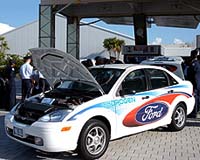
Ford First To Offer Clean-Burning Hydrogen Vehicles
Dearborn, Michigan (AFP) Jul 18, 2006 Ford on Monday became the first automaker to begin production of a commercially viable hydrogen engine, which emits little but clean water vapor into the air. The hydrogen-powered internal combustion engines are destined for shuttle buses and will be ready for delivery later this year, said Ford Motor Co. spokesman Nick Twork. "This engine represents a significant milestone in Ford's research efforts in hydrogen technology," said Gerhard Schmidt, Ford vice president, who has long pushed for using hydrogen as fuel in conventional engines. "We have learned a great deal about hydrogen-powered internal combustion engines during the development phase of this engine," Schmidt said in a statement. Other automakers, including General Motors and BMW, are developing hydrogen fuel-cell engines, so far an extraordinarily expensive way to produce electricity, used largely in space. Because the hydrogen internal combustion engines use mostly conventional parts, they could eventually be produced at around the same cost as gasoline-powered engines, Twork told AFP. He said the main barrier to widespread adoption is creating an infrastructure of hydrogen filling stations. That is why the engines are meant for buses, with regular routes and central fueling systems, which make the cost of installing stations manageable, he explained. The buses are scheduled for delivery to fleet customers later this year, first in Florida and then in other locations across North America, he added. Twork said Ford expects to build about 20 hydrogen-fueled vehicles in the first wave. "We're the only manufacturer with hydrogen internal combustion engines that have actually been validated. We're the automaker working on both internal combustion and fuel cells," he said. Hydrogen-fueled internal combustion engines have many advantages including high efficiency, all-weather capability, and near-zero emissions of regulated pollutants and greenhouse gases. They can also be mated with electric motors in hybrids for further gains in fuel efficiency, Twork said. Ford was criticized by environmental groups last month when it announced that it did not expect to make its original goal of building 250,000 hybrid vehicles annually by the end of the decade. Instead, chief executive officer William Clay Ford Jr. said the automaker would spend more time and effort expanding its lineup of vehicles that run on alternative fuels. Other US automakers have also been slow, when compared with the Japanese, to develop hybrid technology, and have stubbornly built high-profit SUVs, trucks and large cars. Internal combustion engines that create demand for hydrogen fuel would expedite development of fuel cells, which are widely seen as another answer to reducing carbon emissions. Carbon dioxide, from burning fossil fuels such as coal and oil, has contributed to a rise in the globe's temperature in the past century. The hydrogen internal combustion engine buses will provide valuable real-world experience for Ford research into new features, such as direct-injection to enhance power and fuel economy of hydrogen engines, Ford officials said.
Source: Agence France-Presse Community Email This Article Comment On This Article Related Links Ford Car Technology at SpaceMart.com
 Toyota To Expand Hybrid Car Range In US
 Washington (AFP) Jul 18, 2006
Japanese automaker Toyota plans to expand its hybrid offerings in the United States as it struggles to meet demand for its popular Prius car, its top US executive said Tuesday. Toyota Motor North America President Jim Press said the automaker was planning to start selling a sixth hybrid model in the United States from early next year. |
|
|

| The content herein, unless otherwise known to be public domain, are Copyright 1995-2006 - SpaceDaily.AFP and UPI Wire Stories are copyright Agence France-Presse and United Press International. ESA PortalReports are copyright European Space Agency. All NASA sourced material is public domain. Additionalcopyrights may apply in whole or part to other bona fide parties. Advertising does not imply endorsement,agreement or approval of any opinions, statements or information provided by SpaceDaily on any Web page published or hosted by SpaceDaily. Privacy Statement |