|
 |
 |
 |
 |
 |
 |
 |
 |

 |
Fly Me To Mars
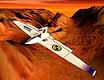
Princeton - February 8, 1999 - NASA hopes to mark the 100th anniversy of the Wright Brothers first powered flight with announced this week it will pursue a project that will culminate in a flight of an airplane in the thin atmosphere of Mars on December 17, 2003, 100 years to the day since Kitty Hawk. The idea for the project was proposed by Princeton University scientists, who said that achieving the feat would have great scientific as well as historic value. "I don't know if your heart pumped as much as mine, but this is going to be an incredible achievement," NASA's Head Administrator Daniel S. Goldin told reporters. The idea was first proposed by Edgar Choueiri, assistant professor in the Department of Mechanical and Aerospace Engineering at Princeton University, in a May 1997 document he circulated among the faculty members of his department and some of his colleagues outside the university. Choueiri's idea was to commemorate the centennial of Orville and Wilbur Wright's first powered flight by flying an airplane in the Martian atmosphere around December 2003. His proposal called for a collaborative effort involving NASA, industry and academe to meet the challenge. Princeton's MAE department communicated Choueiri's idea to Goldin. While NASA had previously considered the idea of flying a plane on Mars, the Princeton proposal of linking such a flight to the Wright flight centennial gave a framework, a timeframe and a motive for such a mission. While the driving objective is to commemorate the centennial of one of the most momentous technological achievements in human history -- the realization of the millennia-old dream of sustained flight -- Choueiri stated in his proposal that such a challenging and ambitious mission would be replete with concrete benefits of great scientific, technological, educational and even historical value. The motivation for pursuing this potentially enthralling endeavor, he explained, stems from its capability to generate direct and spin-off benefits. Since the Martian atmosphere is devoid of air (it is mostly carbon dioxide), the term "airplane" is not very suitable. Instead, Choueiri calls the craft an "Aresplane," in reference to Ares, the Greek name for the god Mars. The challenge of flying the Aresplane stems from the fact that the Martian atmosphere is more than 100 to 150 times thinner than that of Earth at sea level. The difficulty of flight is only a little alleviated by the fact that gravity on Mars is about 2.6 times less that on Earth. The project would force researchers to urgently seek solutions for problems related to materials, airfoil design, dynamics and control and propulsion. These problems correspond to research areas in which Princeton's MAE department has made numerous contributions, and a few MAE professors have been discussing technical aspects of the mission since the idea was put forward in 1997. Aside from advances in related technologies, the project could lead to a better understanding of geological processes that shaped the red planet and its vast canyons. Scientific instruments on the Aresplane could examine the planet's surface with a resolution far exceeding that of orbiting spacecraft. The Princeton proposal noted that this would be the first time an airplane is flown outside our planet and as such it would be a felicitous, historic and, literally, a horizon-widening tribute to a century of flight as well as a resonating statement on the continuing vitality and importance of flight to our evolution.
Surveyor Reports At SpaceDaily Mars 98 Reports From Spacer.Com Mission Links
Mars Coverage at Spacer.Com
Future Missions
Areography
Pathfinder
Email This Article Comment On This Article Related Links Space
 Satellite Launch To Boost DTH In India
 Calcutta, India (SPX) Dec 28, 2005
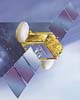
The successful launch Thursday of India's heaviest satellite from spaceport of Kourou in French Guyana may have boosted the country's space research efforts to yet another level, but it has also lifted the spirits of at least three Direct-To-Home televisions broadcasters, one of which has been waiting for years to launch its services in India. |
|
|

|
|
|
|
|
|
|
|
|
|
|
|
| The content herein, unless otherwise known to be public domain, are Copyright 1995-2006 - SpaceDaily.AFP and UPI Wire Stories are copyright Agence France-Presse and United Press International. ESA PortalReports are copyright European Space Agency. All NASA sourced material is public domain. Additionalcopyrights may apply in whole or part to other bona fide parties. Advertising does not imply endorsement,agreement or approval of any opinions, statements or information provided by SpaceDaily on any Web page published or hosted by SpaceDaily. Privacy Statement |