|
 |
 |
 |
 |
 |
 |
 |
 |

 |
Floating In Weightlessness � On Earth
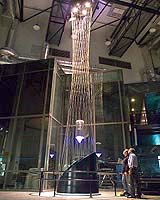
Noordwijk, The Netherlands (ESA) May 09, 2005 "What goes up must come down". Ever since astronauts started playing games in space, for instance catching morsels of food floating in weightlessness conditions, the general public knows that the saying is not necessarily true. Recent reports of EuroNews 'Space' magazine have shown how conditions of weightlessness may be obtained for short periods without going into orbit : from a few seconds to a few minutes. But microgravity conditions can also be recreated for a few seconds on Earth. Last week 'Space' explained how. First stop, the European Space Agency's Research & Technology Centre (ESTEC) at Noordwijk in the Netherlands. In its Erasmus building, some uncanny things happen in an elegant woven-metal structure 13-metres tall. The installation called a drop tower demonstrator was inaugurated last November. A capsule containing an experiment is allowed to drop down the structure and will experience weightlessness for 1.5 seconds before its fall is cushioned in a 1.75 metre deep pit filled with PVC spheres. The ESTEC drop tower is not primarily used for scientific research but as a demonstrator of gravitational effects for students and an interested public and to explain the function of the Zarm drop tower at the University of Bremen in Germany. "The 9 seconds of free-fall that are achieved at the drop-tower of ZARM may not seem long compared to the 25 seconds of parabolic flights or 12 minutes of sounding rockets , but it is enough to give experimenters a good idea of the phenomena they are investigating," comments ESA's Massimo Sabbatini. "It can be a first step before launching on a Russian Foton capsule orbited by the Soyuz launcher which will provide 12 days of microgravity before returning to Earth, or even longer durations on the International Space Station." "Scientists have realised that phenomena such as hydrostatic pressure, sedimentation or convection that are driven by gravity actually mask other phenomena that tend to be ignored or neglected," explains Olivier Minster, Head of the Physical Sciences Unit at ESA. "Freeing ourselves from the influence of gravity enables us to understand and eventually master these hidden phenomena at work in more complex systems." EuroNews visited the ZARM facility, a working laboratory and one of the most important facilities for Europe's microgravity programme, unique in Europe with its impressive 146 metre tower. Every day a large canister is prepared with its sensors and cameras and the various experiments to be observed or tested in conditions of weightlessness. The 400-kg capsule is then hoisted up the tower shaft, and its rapid 110-metre descent is monitored from a control centre. Each free fall offers 4.7 seconds of weightlessness and a catapult-like option at its base offers 9 seconds of weightlessness. "The quality of the microgravity we obtain with the Zarm tower is exceptional, in fact a hundred times better than on the Space Station whose microgravity conditions are perturbed by the human presence," explained Hansj�rg Dittus, the Zarm tower's deputy Director. "In addition, if the experiments can be scaled down they react faster and you conduct about 80% of the experiments you can carry out in the Space Station. But one needs both: the tower to prepare all the experiments and the ISS or orbital systems to make a complete investigation." Innovation is a constant in today's highly technical society. Attention to detail on small things leads to big achievements. The EuroNews report on European ground-based microgravity facilities evokes one of Europe's most recent shining examples : the first flight of the A380 Airbus, a powerhouse of technology. The use of microgravity facilities, drop towers on Earth, or long duration flights in space, is an increasingly important domain in research technology, as Olivier Minster concludes. "Industrial competition is often driven by very small developments, details which make all the difference between rival products or processes. Microgravity experiments increase our understanding and can play a vital role." Community Email This Article Comment On This Article Related Links Human Spaceflight SpaceDaily Search SpaceDaily Subscribe To SpaceDaily Express Space Tourism, Space Transport and Space Exploration News
 Spicing Up Space Meals
 Los Angeles CA (SPX) Jan 04, 2006
Since its launch a year and half ago, Minimus.biz has quickly become the place to go for individual and travel size items. Last week, NASA came to Minimus.biz and purchased several different travel size condiments to send with the astronauts to the International Space Station. |
|
|

| The content herein, unless otherwise known to be public domain, are Copyright 1995-2006 - SpaceDaily.AFP and UPI Wire Stories are copyright Agence France-Presse and United Press International. ESA PortalReports are copyright European Space Agency. All NASA sourced material is public domain. Additionalcopyrights may apply in whole or part to other bona fide parties. Advertising does not imply endorsement,agreement or approval of any opinions, statements or information provided by SpaceDaily on any Web page published or hosted by SpaceDaily. Privacy Statement |