|
 |
 |
 |
 |
 |
 |
 |
 |

 |
Flight Of The Bumblebee: Researchers Find That Flower Choice Matters
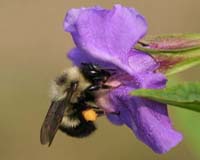
Milwakee WI (SPX) Oct 31, 2006 Rebecca Flanagan has probably come as close as a human can to reading the mind of a bumblebee. Flanagan, a graduate student in biological sciences, and Associate Professor Jeffrey Karron are studying the behaviors of bees as they gather pollen - which plant species the bees forage on, which flowers they probe and in what order, and how many blooms they visit before moving on to another plant. In doing so, the bees make plant reproduction possible by dispersing pollen. To predict where each bee that she tracks will carry its pollen next, Flanagan has to literally think like one. "Once they've learned a foraging style that's been successful, they are more likely to stick with it rather than invest time in learning something new," says Flanagan. But why go to such lengths to map the flight of the bumblebee? It may seem random and inconsequential. But it is neither, says Karron. The bees are pivotal players in determining which plant populations survive through successful reproduction. If scientists could better understand nature's decision-making process, then they could use the information to increase crop yields and to boost conservation of native plant communities.
Best bee practices Because there are many bee behaviors, the task isn't simple, but with tedious scrutiny it is documentable. "Bumblebees definitely have distinct foraging patterns, both among species and even individuals of a single species," Karron says. In fact, some of the many different behaviors lead to far more fruitful propagation than others. To understanding foraging patterns, the team must manipulate every variable they can feasibly control in a natural setting. But the experimental garden they keep at the UWM Field Station in the Cedarburg Bog is far from the sterile laboratory, and the complexity of their experiments becomes immediately evident: There are more options here than clothes in a teenage girl's closet. Nonetheless, Karron and his research group have developed an unparalleled data set by testing the effects of various combinations of plant species on their reproductive patterns. Twice funded by the National Science Foundation, Karron's research centers on the reproductive biology of monkeyflower, a wetland plant native to Wisconsin. Karron's lab uses several innovative methods of tracking monkey flower mating, and all hinge on where the pollen comes from. Pollen allows the flowers, which contain both male and female reproductive organs, to produce seeds. Plants can only produce seeds from their own species' pollen. The pollen from another species deposited on a monkeyflower, for example, is simply wasted. The most effective reproduction occurs through cross-pollination - when pollen deposited on a flower is brought from a different plant of the same species, either from one pollen donor or many. When pollen is spread from one flower to another on the same plant - called self-pollination - seed production is considerably lower and the resulting seedlings are much less vigorous. Using genetic analysis to establish paternity, Karron has demonstrated that adjacent flowers differ markedly in their mating patterns. "It's amazing what we've found," he says. "When a bee visits the first flower on a plant, 80 percent of the seeds are cross-pollinated. But by the time the bees have landed on the fourth flower on that plant, 90 percent of the seeds are self-pollinated."
Bee magnets Flanagan has taken the research of Karron a step further by testing whether the inclusion of purple loosestrife, an invasive weed that chokes wetlands, will affect the seed production of monkeyflower. She has set out the garden in a grid of numbered holes. In this way, she can rotate the kinds of potted plants that are dropped in each morning and the density of each species in the plot. On any given day, Flanagan will trim the plants so that each has the same number of flowers on it. Then she tracks one bee at a time, calling out its exact foraging sequence by number to her undergraduate assistant, Dustin Knutowski, who charts the path. In the time she has spent working at the garden, she says, the invader plant is the heavier "bee magnet." And if that's the case, purple loosestrife is luring pollinators away from the native plants. To investigate her hunch further, Flanagan added a third wetland species to the garden - a native plant known as "great blue lobelia." So far, the bees continue their strong attraction to purple loosestrife. "This preference for purple loosestrife or other exotics could threaten reproduction of native plants and have devastating effects on ecosystems," Karron says.
Who's your daddy? Calculating paternity could be a nightmare. Because pollen from multiple monkey flower plants can be deposited during a single bee visit, seeds produced by one flower can be "sired" by pollen from up to nine different plants. So Karron uses genetic markers to unambiguously determine which plant fathered each of the thousands of seeds he samples. He is working backwards to get at the same question Flanagan seeks - where the bees have been. He divides each of the plants in the garden to create an exact copy of each population. Imagine having 20 sets of identical twins, he says, and dividing them into two groups that are exact copies of one another. That is what Karron has done with his garden, only he has produced many identical sets so that he can subject them to different ecological conditions. Karron is proud of the fine level of detail his techniques have produced. His research group was the first to demonstrate that mating patterns differ dramatically among individual flowers and the first to show that the presence of competing plant species influences mating patterns. "Using multiple strategies," he says, "we are able to answer questions that no one else has." Community Email This Article Comment On This Article Related Links University of Wisconsin-Milwaukee Darwin Today At TerraDaily.com
 Honey Bee Genome Holds Clues To Social Behavior
 Champaign IL (SPX) Oct 24, 2006
By studying the humble honey bee, researchers at the University of Illinois at Urbana-Champaign have come a step closer to understanding the molecular basis of social behavior in humans. "The honey bee (Apis millifera) has been called a model system for social behavior," said Saurabh (pronounced SAW-rub) Sinha, a professor of computer science and an affiliate of the university's Institute for Genomic Biology. |
|
|

| The content herein, unless otherwise known to be public domain, are Copyright 1995-2006 - SpaceDaily.AFP and UPI Wire Stories are copyright Agence France-Presse and United Press International. ESA PortalReports are copyright European Space Agency. All NASA sourced material is public domain. Additionalcopyrights may apply in whole or part to other bona fide parties. Advertising does not imply endorsement,agreement or approval of any opinions, statements or information provided by SpaceDaily on any Web page published or hosted by SpaceDaily. Privacy Statement |