|
 |
 |
 |
 |
 |
 |
 |
 |

 |
Five years Of ISS Crews
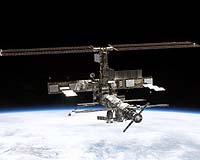
Paris (ESA) Nov 03, 2005 Just over five years ago the Soyuz TM-31 spacecraft was launched into orbit. There had been 30 previous launches of the Soyuz-TM spacecraft, all of which went to the Mir Space Station. This flight however was a landmark in spaceflight history as it carried the first Expedition Crew to the International Space Station where it arrived and docked two days later. On 2 November 2005 it is precisely five years ago that Bill Shephard, Yuri Gidzenko and Sergei Krikalev entered through the hatch between the Soyuz TM-31 spacecraft and the International Space Station establishing a permanently occupied international outpost in space. This marked a new era in human spaceflight, which had officially started with the signing of the ISS Intergovernmental Agreement between the five international partners: USA, Russia, Europe, Canada and Japan in January 1998.
Assembly For Krikalev being on the ISS was not, however, a new experience as he was a member of the first ISS assembly flight as part of the STS-88 Space Shuttle mission in December 1998. He would not be the only astronaut or cosmonaut to be in this situation either, as 16 of the astronauts that took part in the ISS assembly and outfitting missions prior to November 2000 would return on different missions to the ISS, eight of them as members of expedition crews, including the current members of Expedition 12. Since 2 November 2000, the ISS has been visited by nearly 100 astronauts, 28 of which have been on mission to the ISS more than once, including ESA astronaut Roberto Vittori who took part in the European Marco Polo and Eneide missions to the ISS in 2002 and 2005 respectively. Of these nearly 100 astronauts, 29 were members of Expedition crews that have had long-term stays on the ISS from between 129 and 193 days. Since the arrival of the first Expedition crew, there have been about 5800 crew days (almost 16 years) spent by astronauts working at the ISS, 84% of which by the 12 ISS Expedition Crews. In fact to be precise over 500 of the crew days are strictly speaking actually woman days. This includes the first European woman to visit the ISS, former ESA astronaut Claudie Haignere on the Andromede mission in October 2001.
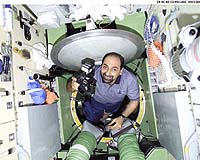
European astronauts Of all the astronauts that have been on mission to the station, seven of these have been European, with six of these being ESA staff members: Roberto Vittori, Andre Kuipers, Pedro Duque, Frank De Winne, Claudie Haignere and Umberto Guidoni. The seventh was Philippe Perrin who at the time of the flight was a CNES staff member and later became a member of ESA's European Astronaut Corps in 2002 before joining Airbus Industries as a test pilot in 2004. These astronauts have accounted for about 90 days of crew days work in space for Europe. This is set to triple when ESA astronaut Thomas Reiter arrives at the ISS next year as the first European member of an ISS Expedition Crew. Reiter is set to fly to the ISS on the following Shuttle mission STS-121 which is currently scheduled for launch after May 2006.
Soyuz and Space Shuttle Since the Expedition 1 Crew arrived at the ISS there have been 11 Soyuz spacecraft to visit the ISS with crew: Four of these were Soyuz TM spacecraft (including the Soyuz TM-31 of the Expedition 1 Crew) and seven of these were Soyuz TMA spacecraft. ESA astronauts were members of the crew on nine of 11 of these spacecraft either to the ISS or from the ISS or on both legs of the flight. This included the first flight of the Soyuz TMA spacecraft with ESA astronaut Frank De Winne on the Odissea Mission in 2002, Andre Kuipers on the DELTA mission in 2004, Pedro Duque on the Cervantes mission in 2003 and the missions of Haignere and Vittori. There have been twelve Shuttle flights to visit the Station since the Expedition 1 Crew arrived. This includes the STS-100 mission which included the first European and ESA astronaut to visit the ISS, Umberto Guidoni, and the flight of Philippe Perrin on the STS-111 mission.
Research on the ISS Research is the central emphasis for the International Space Station and the first European-built internal research facility, which was launched on the STS-111 mission with Perrin was the Microgravity Science Glovebox.

|