|
 |
 |
 |
 |
 |
 |
 |
 |

 |
Five Spacecraft Join to Solve an Auroral Puzzle
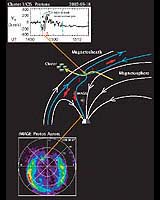
Washington - May 22, 2003 Five spacecraft have made a remarkable set of observations, leading to a breakthrough in understanding the origin of a peculiar and puzzling type of aurora. Seen as bright spots in Earth's atmosphere and called "dayside proton auroral spots," they are now known to occur when fractures appear in the Earth's magnetic field, allowing particles emitted from the Sun to pass through and collide with molecules in our atmosphere. On March 18, 2002, a jet of energetic solar protons collided with the Earth's atmosphere and created a bright "spot" seen by NASA's IMAGE spacecraft, just as the European Space Agency's (ESA) four Cluster spacecraft passed overhead and straight through the proton jet. This is the first time that a precise and direct connection between the proton jet and bright spot has been made, and it results from the simultaneous observations by Cluster and IMAGE. The results of the study are published May 21 in Geophysical Research Letters, a journal of the American Geophysical Union, in a paper by Tai Phan of the University of California in Berkeley and 24 international colleagues. Earth's magnetic field acts as a shield, protecting the planet from the constant stream of tiny particles ejected by the Sun, known as the solar wind. The solar wind itself is a stream of hydrogen atoms, separated into their constituent protons and electrons. When electrons find routes into our atmosphere, they collide with and "excite" the atoms in the air. When these excited atoms release their energy, it is emitted as light, creating the glowing "curtains" we see as the aurora borealis in the far north and aurora australis in the far south. Dayside proton auroral spots are caused by protons "stealing" electrons from the atoms in our atmosphere. An extensive analysis of the Cluster results has now shown that the region was experiencing a turbulent event known as "magnetic reconnection." Such a phenomenon takes place when the Earth's usually impenetrable magnetic field fractures and has to find a new stable configuration. Until the field mends itself, solar protons leak through the gap and jet into Earth's atmosphere, creating the dayside proton aurora. Philippe Escoubet, ESA's Cluster Project Scientist, comments, "Thanks to Cluster's observations, scientists can directly and firmly link for the first time a dayside proton auroral spot and a magnetic reconnection event." Tai Phan, leader of the investigation, now looks forward to a new way of studying the Earth's protective shield. He says, "This result has opened up a new area of research. We can now watch dayside proton aurorae and use those observations to know where and how the cracks in the magnetic field are formed and how long the cracks remain open. That makes it a powerful tool to study the entry of the solar wind into the Earth's magnetosphere." Proton auroras were globally imaged for the first time by NASA's IMAGE (Imager for Magnetopause-to-Aurora Global Exploration) spacecraft, which revealed the presence of dayside proton auroral spots. ESA's Cluster is a collection of four spacecraft, launched on two Russian rockets during the summer of 2000. They fly in formation around the Earth, relaying the most detailed information ever about how the solar wind affects the planet. The principal investigators for the instruments in the current study were Henri Reme of CESR/Toulouse, France (Cluster Proton Detectors), Andre Balogh of Imperial College, London, United Kingdom (Cluster Magnetic Field Instrument), and Stephen Mende of University of California, Berkeley (IMAGE/FUV). "Simultaneous Cluster and IMAGE Observations of Cusp Reconnection and Auroral Spot for Northward IMF" Citation: T. Phan, H. U. Frey, S. Frey, L. Peticolas, S. Fuselier, C. Carlson, H. Reme, J.-M. Bosqued, A. Balogh, M. Dunlop, L. Kistler, C. Mouikis, I. Dandouras, J.-A. Sauvaud, S. Mende, J. McFadden, G. Parks, E. Moebius, B. Klecker, G. Paschmann, M. Fujimoto, S. Petrinec, M. F. Marcucci, A. Korth, and R. Lundin, Simultaneous Cluster and IMAGE observations of cusp reconnection and auroral proton spot for northward IMF, Geophys. Res. Lett., 30(10), 1509, doi:10.1029/2003GL016885, 2003. Community Email This Article Comment On This Article Related Links Space Sciences Laboratory, University of California European Space Agency SpaceDaily Search SpaceDaily Subscribe To SpaceDaily Express Dirt, rocks and all the stuff we stand on firmly
 Magnetic Reconnection Region Larger Than 2.5 Million Km Found In The Solar Wind
 Paris (ESA) Jan 12, 2006
Using the ESA Cluster spacecraft and the NASA Wind and ACE satellites, a team of American and European scientists have discovered the largest jets of particles created between the Earth and the Sun by magnetic reconnection. This result makes the cover of this week's issue of Nature. |
|
|

| The content herein, unless otherwise known to be public domain, are Copyright 1995-2006 - SpaceDaily.AFP and UPI Wire Stories are copyright Agence France-Presse and United Press International. ESA PortalReports are copyright European Space Agency. All NASA sourced material is public domain. Additionalcopyrights may apply in whole or part to other bona fide parties. Advertising does not imply endorsement,agreement or approval of any opinions, statements or information provided by SpaceDaily on any Web page published or hosted by SpaceDaily. Privacy Statement |