|
 |
 |
 |
 |
 |
 |
 |
 |

 |
First evidence emerges of pest resistance to GM crops: scientists
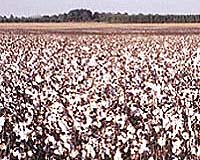
Paris (AFP) Feb 8, 2008 Scientists poring over a mass of studies into the response of pests to genetically-modified cotton say they have found the first confirmation that insects have developed resistance to transgenic crops. University of Arizona entomologists looked at data from six experiments to monitor pests in fields sown with transgenic cotton and corn in Australia, China, Spain and the United States. They found evidence of genetic mutation among bollworms (Helicoverpa zea) in a dozen cotton fields sown in Mississippi and Arkansas between 2003 and 2006. But no such evidence was found among five other major pests monitored elsewhere. The mutation entails a slight change in the bollworm's DNA to help it resist a toxin that the cotton plant exudes thanks to a gene inserted by biotechnologists. These GM toxins are produced in nature by a widespread bacterium called Bacillus thuringiensis, which goes by the abbreviation Bt. The type of Bt toxin to which these bollworms have become resistant is called Cry1Ac. "What we're seeing is evolution in action," said lead researcher Bruce Tabashnik. "This is the first documented case of field-evolved resistance to a Bt crop." Tabashnik said a new variety of Bt cotton was successfully combatting the resistant bollworms as it combined a second toxin, Cry2Ab, with Cry1Ac. Green groups, who are fierce opponents of GM technology in agriculture, have long predicted that pests would become resistant to transgenic toxins, as happens frequently in the case of chemical insecticides. To overcome the resistance, scientists would have to use higher levels of toxins or different kinds, they say. On the other hand, the paper, published on Thursday in the British journal Nature Biotechnology, found no evidence of resistance among the other insect pests being monitored. They remained susceptible to Bt toxin. Worst-case scenarios sketched by critics of GM crops have predicted that pests would become resistant to Bt crops in as little as three years, said Tabashnik. "The resistance occurred in one particular pest in one part of the US," Tabashnik said. "The other major pests attacking Bt crops have not evolved resistance. And even most bollworm populations have not evolved resistance." Bt cotton and Bt corn, introduced by the US agri-giant Monsanto in 1996, have been grown on more than 162 million hectares (400 million acres) worldwide, "generating one of the largest selections for insect resistance ever known," notes the paper. Resistance among the bollworms developed faster in places where there was little or no "refuges," the term for areas where there are non-BT crops, the review found. The idea behind refuges is to provide a haven for pests that do not have the genetic mutations. This boosts the probability that a resistant pest will mate with a non-resistant pest, creating a hybrid that would still be susceptible to the toxin. In most pests, offspring are resistant to the novel toxins only if both parents are resistant. Community Email This Article Comment On This Article Related Links Farming Today - Suppliers and Technology
 Study: Nitrogen pollution ups plant growth
 Irvine, Calif. (UPI) Feb 7, 2008
 U.S. ecologists have found excess nitrogen in tropical forests boosts plant growth by an average of 20 percent. |
|
|

| The content herein, unless otherwise known to be public domain, are Copyright 1995-2007 - SpaceDaily.AFP and UPI Wire Stories are copyright Agence France-Presse and United Press International. ESA Portal Reports are copyright European Space Agency. All NASA sourced material is public domain. Additional copyrights may apply in whole or part to other bona fide parties. Advertising does not imply endorsement,agreement or approval of any opinions, statements or information provided by SpaceDaily on any Web page published or hosted by SpaceDaily. Privacy Statement |