|
 |
 |
 |
 |
 |
 |
 |
 |

 |
First Visual Another Side Of Mercury
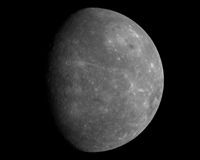
Laurel MD (SPX) Jan 16, 2008 When Mariner 10 flew past Mercury three times in 1974 and 1975, the same hemisphere was in sunlight during each encounter. As a consequence, Mariner 10 was able to image less than half the planet. Planetary scientists have wondered for more than 30 years about what spacecraft images might reveal about the hemisphere of Mercury that Mariner 10 never viewed. On January 14, 2008, the MESSENGER spacecraft observed about half of the hemisphere missed by Mariner 10. This image was snapped by the Wide Angle Camera, part of the Mercury Dual Imaging System (MDIS) instrument, about 80 minutes after MESSENGER's closest approach to Mercury (2:04 pm EST), when the spacecraft was at a distance of about 27,000 kilometers (about 17,000 miles). The image shows features as small as 10 kilometers (6 miles) in size. This image was taken through a filter sensitive to light near the red end of the visible spectrum (750 nm), one of a sequence of images taken through each of MDIS's 11 filters. Like the previously mapped portion of Mercury, this hemisphere appears heavily cratered. It also reveals some unique and distinctive features. On the upper right is the giant Caloris basin, including its western portions never before seen by spacecraft. Formed by the impact of a large asteroid or comet, Caloris is one of the largest, and perhaps one of the youngest, basins in the Solar System. The new image shows the complete basin interior and reveals that it is brighter than the surrounding regions and may therefore have a different composition. Darker smooth plains completely surround Caloris, and many unusual dark-rimmed craters are observed inside the basin. Several other multi-ringed basins are seen in this image for the first time. Prominent fault scarps (large ridges) lace the newly viewed region. Other images obtained during the flyby will reveal surface features in color and in much more detail. Collectively, these images and measurements made by other MESSENGER instruments will soon provide a detailed global view of the surface of Mercury, yielding key information for understanding the formation and geologic history of the innermost planet. Community Email This Article Comment On This Article Related Links Desktop available - 1360x768 - 1280x1024 - 1024x768 Credit: NASA/Johns Hopkins University Applied Physics Laboratory/Carnegie Institution of Washington News Flash at Mercury Mars News and Information at MarsDaily.com Lunar Dreams and more
 US space probe glides over Mercury in first visit since '75
 Washington (AFP) Jan 14, 2008
The US space probe soared over Mercury on Monday on a mission to unlock the mysteries of the smallest planet of the solar system which was last visited in 1975, NASA said. |
|
|

| The content herein, unless otherwise known to be public domain, are Copyright 1995-2007 - SpaceDaily.AFP and UPI Wire Stories are copyright Agence France-Presse and United Press International. ESA Portal Reports are copyright European Space Agency. All NASA sourced material is public domain. Additional copyrights may apply in whole or part to other bona fide parties. Advertising does not imply endorsement,agreement or approval of any opinions, statements or information provided by SpaceDaily on any Web page published or hosted by SpaceDaily. Privacy Statement |