|
 |
 |
 |
 |
 |
 |
 |
 |

 |
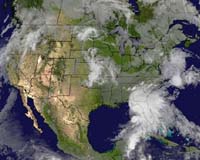
First Tropical Storm Of The Year Hits Western Florida
Miami (AFP) Jun 14, 2006 This year's first Atlantic tropical storm dumped rain on Florida Tuesday, but with memories still fresh of last year's killer storms, locals were relieved that it failed to become a hurricane. The center of Tropical Storm Alberto made landfall at 12:30 pm (1630 GMT) near Adam's Beach, a sparsely inhabited area of western Florida, according to the National Hurricane Center (NHC.) The NHC had initially issued a hurricane warning for parts of Florida's Gulf of Mexico coast, but the storm failed to strenghten into the first hurricane of 2006. Authorities nevertheless warned residents to brace for coastal storm surge flooding as the storm moves inland. The storm also could spawn tornadoes in parts of Florida, Georgia and South Carolina, the NHC said. Before it hit land, Alberto had maximum sustained winds of 85 kilometers per hour (50 mph.) The windspeed was expected to weaken as the center of the storm moves over land. Mindful of the devastation caused by Katrina and other hurricanes last year, authorities took no chances. On Monday they ordered the evacuation of about 20,000 people living in mobile homes and low-lying areas, and Governor Jeb Bush decreed a state of emergency, which allows him to mobilize emergency personnel and National Guard troops. In the city of Tampa, a small plane slammed into a house on Monday, killing one person. Authorities said it was unclear whether the severe weather already affecting the area played a role in the crash. In Cuba, authorities had evacuated 28,000 people as the storm swept past the island on Monday, packing winds of almost 115 kph (70 mph.) Eight people were injured, four homes were destroyed and 48 others damaged by a tornado at Nueva Paz, south of Havana, which was whipped up by Alberto, television reports said. Alberto is the first Atlantic tropical storm since last year's record-smashing season of 28 named storms, 15 of which became hurricanes. Several of the hurricanes blasted across Florida, including the season's worst, Katrina, which left 1,300 people dead and tens of thousands homeless along the Louisiana and Mississippi Gulf Coast. The city of New Orleans is still struggling to recover and engineers have warned its levees may not withstand another Katrina-style battering. The Atlantic hurricane season officially started on June 1 and lasts until November 30. US weather experts are forecasting between eight to 10 hurricanes - as many as six of them major - would form in the Atlantic basin this year.
Source: Agence France-Presse Community Email This Article Comment On This Article Related Links - Bringing Order To A World Of Disasters When the Earth Quakes A world of storm and tempest
 Indonesia Downgrades Mount Merapi Alert
 Mount Merapi (AFP) Jun 14, 2006
Indonesia Tuesday downgraded its top alert on Mount Merapi volcano as scientists said they no longer believe an eruption is imminent. Merapi - whose name means "Mountain of Fire" - was put on red alert on May 13 and its activity has fluctuated since then. It has declined substantially since Friday when part of a lava dome forming at its peak collapsed. |
|
|

| The content herein, unless otherwise known to be public domain, are Copyright 1995-2006 - SpaceDaily.AFP and UPI Wire Stories are copyright Agence France-Presse and United Press International. ESA PortalReports are copyright European Space Agency. All NASA sourced material is public domain. Additionalcopyrights may apply in whole or part to other bona fide parties. Advertising does not imply endorsement,agreement or approval of any opinions, statements or information provided by SpaceDaily on any Web page published or hosted by SpaceDaily. Privacy Statement |