|
 |
 |
 |
 |
 |
 |
 |
 |

 |
First Test: Main Parachute For Ares I Rocket
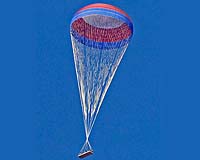
Yuma AZ (SPX) Oct 04, 2007 NASA and industry engineers successfully completed the first drop test of the main parachute that will help recover the first stage of the Ares I crew launch vehicle. Ares I will carry the NASA's Orion crew exploration vehicle to space. The test, conducted on September 25 at the U.S. Army's Yuma Proving Ground near Yuma, Ariz., is part of an ongoing series of tests to support the design and development of the Ares I parachute recovery system, which is derived from the system NASA uses to recover the space shuttle's solid rocket boosters after launch. Tests for the pilot, drogue and three main parachutes will continue through 2010. The next test is scheduled for November 2007. The main parachute was dropped from a U.S. Air Force C-17 aircraft with a 40,600-pound load at an altitude of 17,500 feet. The parachute and all test hardware functioned properly and landed safely on the Yuma Proving Ground test range. NASA's Marshall Space Flight Center, Huntsville, Ala., manages the Ares Project and leads the design and development of the solid rocket booster recovery system. ATK Launch Systems near Brigham City, Utah, is the prime contractor for the first stage booster. ATK's subcontractor, United Space Alliance of Houston, is designing, developing and testing the parachutes at its facilities at NASA's Kennedy Space Center in Florida. NASA's Johnson Space Center in Houston hosts the Constellation Program and Orion Project Office and provides test instrumentation and support personnel. Community Email This Article Comment On This Article Related Links Constellation Program Space Tourism, Space Transport and Space Exploration News
 European Agency Offers To Take Indians For A Space Ride
 New Delhi, India (DPA) Oct 03, 2007
Any Indian who can cough up about 283,881 dollars can button up for a sub-orbital ride around the Earth 2012 onwards, the European space company, EADS Astrium, said Friday at the International Astronautical Congress in India's southern city Hyderabad. EADS Astrium is the space subsidiary of the French-Spanish-German consortium EADS. |
|
|

| The content herein, unless otherwise known to be public domain, are Copyright 1995-2007 - SpaceDaily.AFP and UPI Wire Stories are copyright Agence France-Presse and United Press International. ESA Portal Reports are copyright European Space Agency. All NASA sourced material is public domain. Additional copyrights may apply in whole or part to other bona fide parties. Advertising does not imply endorsement,agreement or approval of any opinions, statements or information provided by SpaceDaily on any Web page published or hosted by SpaceDaily. Privacy Statement |