|
 |
 |
 |
 |
 |
 |
 |
 |

 |
First Solar Dynamic Observatory Instrument Arrives At Goddard
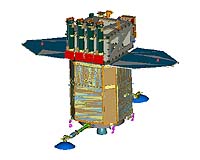
Boulder CO (SPX) Sep 10, 2007 The University of Colorado at Boulder delivered the Extreme Ultraviolet Variability Experiment (EVE), first of three Solar Dynamic Observatory instruments, to NASA Goddard Space Flight Center, Greenbelt, Md. EVE will measure how much the sun's ultraviolet brightness changes. Rapid changes in the ultraviolet radiation of the sun can cause outages in radio communications and affect satellites orbiting the Earth. Increases in solar ultraviolet radiation from flares heat Earth's upper atmosphere, causing it to expand. The expansion makes the air more dense at low-Earth-orbit altitudes, where many satellites fly. The more dense air increases the drag on these satellites, slowing them down and causing them to prematurely burn up in the lower atmosphere if there is no more fuel onboard to give them a boost. EVE will take measurements of the sun's ultraviolet brightness as often as every ten seconds, providing space weather forecasters with warnings of communications and navigation outages. The sun's extreme ultraviolet output constantly changes. The small solar flares that happen almost every day can double the output while the large flares that happen about once a month can increase the ultraviolet a 1000 times in minutes. This harmful ultraviolet radiation is completely absorbed in the atmosphere, which means we can only observe it from satellites. "LASP is very excited about delivering the state-of-the-art EVE instrument to measure the solar extreme ultraviolet irradiance with best ever spectral resolution and time cadence," said Tom Woods, SDO EVE Principal Investigator. "These future SDO EVE measurements are important for many different space weather applications such as how solar storms can degrade or even disrupt our navigation and communications." After launch SDO will study how solar activity is created and how space weather comes from that activity. SDO is designed to help us understand the sun's influence on Earth and near-Earth space by studying the solar atmosphere on small scales of space and time and in many wavelengths simultaneously. SDO's other instruments include Helioseismic and Magnetic Imager (HMI) and Atmospheric Imaging Assembly (AIA). Those instruments are expected to arrive at Goddard by the end of October. "These three instruments together will enable scientists to better understand the causes of violent solar activity, and whether it's possible to make accurate and reliable forecasts of space weather," said Liz Citrin, SDO Project Manager at NASA Goddard. "SDO will provide a full disk picture of the sun in Super HD quality." SDO is the first mission of NASA's Living With a Star program, which seeks to understand the causes of solar variability and its impacts on Earth. SDO is being designed, managed, and assembled at NASA Goddard. HMI is being built by Stanford University, Stanford, Calif. AIA is being built by the Lockheed Martin Solar Astrophysics Laboratory (LMSAL), Palo Alto, Calif. EVE is being built by the University of Colorado. Community Email This Article Comment On This Article Related Links Solar Dynamics Observatory Space Telescope News and Technology at Skynightly.com
 Networks Create Instant World Telescope
 Canberra, Australia (SPX) Sep 10, 2007
For the first time, a CSIRO radio telescope has been linked to others in China and Europe in real-time, demonstrating the power of high-speed global networks and effectively creating a telescope almost as big as the Earth. Last week a CSIRO telescope near Coonabarabran NSW was used simultaneously with one near Shanghai, China, and five in Europe to observe a distant galaxy called 3C273. |
|
|

| The content herein, unless otherwise known to be public domain, are Copyright 1995-2007 - SpaceDaily.AFP and UPI Wire Stories are copyright Agence France-Presse and United Press International. ESA Portal Reports are copyright European Space Agency. All NASA sourced material is public domain. Additional copyrights may apply in whole or part to other bona fide parties. Advertising does not imply endorsement,agreement or approval of any opinions, statements or information provided by SpaceDaily on any Web page published or hosted by SpaceDaily. Privacy Statement |