|
 |
 |
 |
 |
 |
 |
 |
 |

 |
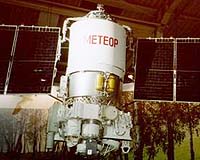
First Remote Sensing Satellite To Be Launched In Late 2006
Moscow, Russia (SPX) Nov 16, 2005 The first satellite for the remote sensing of the Earth will be launched in late 2006, a senior space official said Tuesday, reports RIA Novosti. "The first remote sensing satellite, Meteor 3M, will be launched at the end of 2006," Grigory Chernyavsky, the general designer of remote sensing systems at the Russian Federal Space Agency, told a conference on remote sensing. Chernyavsky said the Federal Space Program for 2006-2015 suggested the creation of seven remote sensing systems to obtain "fundamental knowledge about the Earth and monitor natural resources". The official also said the main objectives outlined in the Federal Space Program were to restore and develop a remote sensing orbital group and create infrastructure for the access of the users of such systems, who include the Emergency Situations Ministry, the Agriculture Ministry, the Ministry of Transportation, the Federal Service for Hydrometeorology and Environmental Monitoring, the Natural Resources Ministry and the Russian Academy of Sciences. Chernyavsky said the program distinguished between space systems for hydro-meteorological monitoring, systems for monitoring the Earth and radio-radar systems. Community Email This Article Comment On This Article Related Links SpaceDaily Search SpaceDaily Subscribe To SpaceDaily Express Earth Observation News - Suppiliers, Technology and Application
 New Legislation Initiated To Support Commercial Remote Sensing Industry
 New York NY (SPX) Jan 11, 2006
The importance of remotely sensed data and technologies to support natural disasters has prompted attention and action in Washington. New initiatives and legislation authorizing appropriations to the remote sensing industry will be discussed at Strategic Research Institute's U.S. Commercial Remote Sensing Industry conference, scheduled for February 9-10, 2006 in Washington D.C. |
|
|

| The content herein, unless otherwise known to be public domain, are Copyright 1995-2006 - SpaceDaily.AFP and UPI Wire Stories are copyright Agence France-Presse and United Press International. ESA PortalReports are copyright European Space Agency. All NASA sourced material is public domain. Additionalcopyrights may apply in whole or part to other bona fide parties. Advertising does not imply endorsement,agreement or approval of any opinions, statements or information provided by SpaceDaily on any Web page published or hosted by SpaceDaily. Privacy Statement |