|
 |
 |
 |
 |
 |
 |
 |
 |

 |
First Martian Shooting Star Traced Back To Ancient Comet
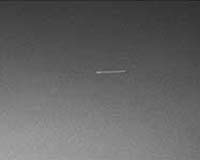
Paris (AFP) Jun 01, 2005 The first meteor ever to be seen on Mars has been traced to a trail left by Comet Wiseman-Skiff, a wanderer of the Solar System that takes six and a half years to orbit the Sun, French astronomers believe. The meteor was recorded as a long streak against the inky Martian sky on March 7 2004 by the panoramic camera of Spirit, the US Mars exploration rover. Writing on Thursday in the British science journal Nature, the team suggests the grazing trajectory of the streak shows it was caused by debris deposited in past years by Wiseman-Skiff. Comets are believed to be masses of primitive rocks and dust, held together by ice, that are doomed to swing around the Sun. As they get closer to the Sun, some of the icy layers are stripped away, leaving a gassy wake that is reflected in the Sun and, to star-gazers, looks like a tail. The dust and pebbles that they deposit also travel in orbit. When this debris crosses the path of an atmospheric planet, it expires as meteors, burning up through friction. If the pieces are big enough to survive the burn, the remains are called meteorites. Wiseman-Skiff was first identified in 1987 by US astronomers Jennifer Wiseman and Brian Skiff. The French researchers, led by Franck Selsis of the Centre for Astronomical Research in Lyon, believe that Mars has annual "showers" of meteors, lasting several days, as the Wiseman-Skiff's dusty trail collides with the Red Planet's thick carbon-dioxide atmosphere. There may also be "swarms" of meteors if Mars crosses a thick recent deposit, they say, calculating that there are good prospects for such an event on December 20 2007. The showers could be characterised as "Martian Cepheids," they suggest, as the meteors, as seen from Mars' perspective, appear to come from the constellation Cepheus (the King). Similar names are given to earthly meteor showers -- the annual Leonids, for instance, are so dubbed because they appear to come from the constellation Leo, the Lion. Community Email This Article Comment On This Article Related Links SpaceDaily Search SpaceDaily Subscribe To SpaceDaily Express Asteroid and Comet Mission News, Science and Technology
 NASA'S Spitzer Finds Possible Comet Dust Around Dead Star
 Pasadena CA (SPX) Jan 12, 2006
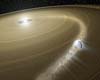
NASA's Spitzer Space Telescope has spotted what may be comet dust sprinkled around the white dwarf star G29-38, which died approximately 500 million years ago. |
|
|

| The content herein, unless otherwise known to be public domain, are Copyright 1995-2006 - SpaceDaily.AFP and UPI Wire Stories are copyright Agence France-Presse and United Press International. ESA PortalReports are copyright European Space Agency. All NASA sourced material is public domain. Additionalcopyrights may apply in whole or part to other bona fide parties. Advertising does not imply endorsement,agreement or approval of any opinions, statements or information provided by SpaceDaily on any Web page published or hosted by SpaceDaily. Privacy Statement |