|
 |
 |
 |
 |
 |
 |
 |
 |

 |
First Map Of Structural Variation In The Human Genome Under Construction
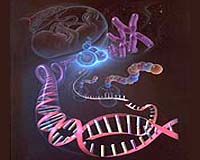
Cold Spring Harbor NY (SPX) Nov 23, 2006 Beyond the simple stream of one-letter characters in the human genome sequence lies a complex, higher-order code. In order to decipher this level of architecture, scientists have developed powerful new experimental and algorithmic methods to detect copy number variants (CNVs)--defined as large deletions and duplications of DNA segments. These technologies--reported in the journal Genome Research--were used to create the first comprehensive map of CNVs in the human genome, concurrently published in Nature. A related article appears in Nature Genetics. CNVs are responsible for genetic changes in Alzheimer's and Parkinson's, susceptibility to HIV-1, some forms of color blindness, and many other diseases. They lead to variation in gene expression levels and may account for a large amount of phenotypic variation among individuals and ethnic populations, including differential responses to drugs and environmental stimuli. Mechanisms underlying the formation of CNVs also provide insight into evolutionary processes and human origins. Using microarray technology, scientists can scan for CNVs across the genome in a single experiment. While this is a cost-effective means of obtaining large amounts of data, scientists have struggled to accurately determine CNV copy number and to precisely define the boundaries of CNVs in the genome. Two papers published today in Genome Research present groundbreaking approaches to address these issues. One paper describes a new whole-genome tiling path microarray, which was constructed from the same DNA used to sequence the human genome in 2001. The array covers 93.7% of the euchromatic (gene-containing) regions of the human genome and substantially improves resolution over previous arrays. The array was employed in a process known as comparative genomic hybridization (CGH), which involves tagging genomic DNA from two individuals and then co-hybridizing it to the array. Data from the array were assessed with a new algorithmic tool, called CNVfinder, which accurately and reliably identified CNVs in the human genome. "This method helped us to develop the first comprehensive map of structural variation in the human genome," says Dr. Nigel Carter, one of the lead investigators on the project. "We used it to help identify 1,447 CNVs, which covered 12% of the human genome." The other paper presents a new multi-step algorithm used with the Affymetrix GeneChip� Human Mapping 500K Early Access SNP arrays. The specificity of the algorithm, coupled with the increased probe density of these arrays, permitted the identification of approximately 1,000 CNVs, many of which were below the detection size limit of alternative methodologies. Furthermore, the algorithm more accurately estimated CNV boundaries, thereby permitting a detailed comparison with other genomic features. "This new approach will be useful in understanding the role of CNVs in disease pathology--not only copy number changes in cancer cells, but also possible association of CNVs with common diseases," explains Dr. Hiroyuki Aburatani, one of the scientists who led the development of the algorithm. "We'll be able to develop diagnostic tests with sub-microscopic resolution, and because the analysis detects SNPs--single-nucleotide polymorphisms--in addition to CNVs, it will find widespread use among researchers performing disease-association studies." Community Email This Article Comment On This Article Related Links Cold Spring Harbor Laboratory Genome Research All About Human Beings and How We Got To Be Here All About Human Beings and How We Got To Be Here
 Genetic Variation Shows We're More Different Than We Thought
 Chevy Chase, MD (SPX) Nov 23, 2006
New research shows that at least 10 percent of genes in the human population can vary in the number of copies of DNA sequences they contain--a finding that alters current thinking that the DNA of any two humans is 99.9 percent similar in content and identity. This discovery of the extent of genetic variation, by Howard Hughes Medical Institute (HHMI) international research scholar Stephen W. Scherer, and colleagues, is expected to change the way researchers think about genetic diseases and human evolution. |
|
|

| The content herein, unless otherwise known to be public domain, are Copyright 1995-2006 - SpaceDaily.AFP and UPI Wire Stories are copyright Agence France-Presse and United Press International. ESA PortalReports are copyright European Space Agency. All NASA sourced material is public domain. Additionalcopyrights may apply in whole or part to other bona fide parties. Advertising does not imply endorsement,agreement or approval of any opinions, statements or information provided by SpaceDaily on any Web page published or hosted by SpaceDaily. Privacy Statement |