|
 |
 |
 |
 |
 |
 |
 |
 |

 |
First Ground Tests For Latest Milstar Series
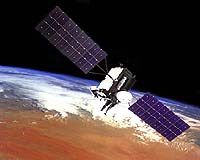
Redondo Beach - Aug 26, 2003 Northrop Grumman Corporation has received the first test terminal for the Department of Defense's next-generation Advanced Extremely High Frequencies (EHF) satellite system from Massachusetts Institute of Technology's Lincoln Laboratory. Northrop Grumman Space Technology is developing the satellite communications payloads for the system, which will deliver secure, high-speed network-centric communications with anywhere, anytime access to U.S. and allied forces. The terminal, AEHF Universal System Test-Terminal, (AUST-T), provides the means for Northrop Grumman to test the compatibility of the satellite payloads with Advanced EHF ground terminals that military forces will use to communicate via satellite. AUST-T will also test the backward compatibility of the Advanced EHF payloads with ground terminals of the current Milstar system. "Our early verification of payload-terminal compatibility using the AUST-T is a critical step in developing the Advanced EHF system," said Clayton Kau, Northrop Grumman Space Technology vice president and Advanced EHF payload program manager. "Existence of this standard will reduce design errors and debugging time for terminal developers." When fielded, Advanced EHF ground terminals will provide warfighters with important new capabilities. These include delivery of protected communications services at rates as high as 8 megabits per second, or five times faster than is possible with today�s Milstar medium-data-rate services. The higher rates will enable satellite communications support for new missions and reduced transmission times for current missions. The new terminals will also extend the data rates for highly robust survivable communications to 19.2 kilobits per second. Kau added that the AUST-T provides many features that will not be part of standard terminals. They include capabilities for measuring performance, logging interactions and capturing data, executing repeatable tests, and investigating system operations and problems. In all, a total of six AUST-Ts will play a key role in development of the Advanced EHF satellite system. In developing the AUST-T, the Lincoln Laboratory built upon its experience with the Advanced EHF digital-processor engineering model, developed in an earlier risk-reduction program at Northrop Grumman and delivered in 2000 to Lincoln Laboratory. Lockheed Martin, under contract to the U.S. Air Force Space & Missile Systems Center, is the Advanced EHF system integrator and is developing the satellite bus at its Sunnyvale, Calif., facility. Community Email This Article Comment On This Article Related Links SpaceDaily Search SpaceDaily Subscribe To SpaceDaily Express Military Space News at SpaceWar.com
 Space Group To Activate New Unit
 Colorado Springs CO (SPX) Jan 6, 2006
Air Force Reserve Command's 310th Space Group will travel deeper into the space program when it activates a new unit Jan. 7. Headquarters Reserve National Security Space Institute will be a Reserve associate unit to the National Security Space Institute in Colorado Springs, Colo. The institute is the Department of Defense's focal point for providing education about space power in joint warfighting. |
|
|

| The content herein, unless otherwise known to be public domain, are Copyright 1995-2006 - SpaceDaily.AFP and UPI Wire Stories are copyright Agence France-Presse and United Press International. ESA PortalReports are copyright European Space Agency. All NASA sourced material is public domain. Additionalcopyrights may apply in whole or part to other bona fide parties. Advertising does not imply endorsement,agreement or approval of any opinions, statements or information provided by SpaceDaily on any Web page published or hosted by SpaceDaily. Privacy Statement |