|
 |
 |
 |
 |
 |
 |
 |
 |

 |
First Galileo Satellites Named 'GIOVE'
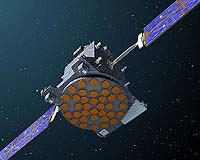
Paris (ESA) Nov 10, 2005 GIOVE - standing for 'Galileo In-Orbit Validation Element' - is the name that has been chosen for the two satellites which are currently being prepared to take the first step of the In-Orbit Validation phase towards full deployment of Galileo, the European satellite navigation system. The name GIOVE was announced by Ms Karla Peijs, the Dutch Minister of Transport, Public Works & Water Management, on Wednesday 9 November, at ESA's ESTEC centre in Noordwijk (The Netherlands). GIOVE A, the first of the two satellites, was presented to the media while undergoing final preparations at the ESTEC test facilities prior to being sent to the Baikonur cosmodrome in Kazakhstan, from where it will be launched by a Soyuz rocket at the end of December 2005. The second, GIOVE B, will be launched later in 2006, also from Baikonur. Naming the satellites GIOVE pays fitting tribute to the achievements of Galileo Galilei (1564-1642) not only in the field of astronomy but also navigation. On 7 January 1610, as one of the first to turn his telescope to the sky, the famous scientist discovered the first four satellites of the planet Jupiter. These were later named Io, Europa, Ganymede and Callisto. Galileo realised that the formation of these four satellites, whose eclipses are frequent and visible, provided a clock whose face could be seen from every point on the Earth. Tables describing the motion of the first four Jovian satellites to be discovered were used to determine longitude at sea and on land. Galileo's method of determining longitude by observing the eclipses of Jovian satellites heralded a revolution in navigation, geodesy and cartography in the 17th and 18th Centuries. Almost 400 years on, another revolution in navigation is on its way, with the advent of Europe's Galileo positioning infrastructure. GIOVE satellites A and B mark the start of in-orbit validation of this new system. They will be followed by four other satellites, to be launched in 2008. GIOVE and its four successors will pave the way for the deployment of the complete Galileo constellation of 30 satellites. This will provide unprecedented satellite positioning, navigation and timing capabilities in the 21st Century.
Background This first step in the Galileo programme, known as the Galileo System Test Bed (GSTB), involves the launch of two satellites for in-orbit testing of critical technologies such as atomic clocks and novel navigation signals specifically developed for the programme. It will also secure the frequencies allocated to Galileo by the International Telecommunications Union (ITU). Until now going under the more technical names of GSTB-V2/A and GSTB-V2/B, these first two GIOVE satellites are elements of the In-Orbit Validation phase of the Galileo programme. GIOVE A (GSTB-V2/A) is at present undergoing its final environmental test campaign on the facilities at the Agency's ESTEC test centre. The second, GIOVE B (GSTB-V2/B), is undergoing final integration tests on the Alenia Spazio facilities in Rome (Italy). Thus, Galileo, Europe's innovative satellite navigation system, is getting ready for launch, preparing to deliver an innovative and advanced civil global positioning service for the benefit of citizens throughout Europe and worldwide. GIOVE A is being developed by Surrey Satellite Technology Ltd (UK). It is designed to fulfil the following main objectives: secure frequency filings, validate key technologies such as rubidium clocks, characterise the orbital environment and deliver signal broadcasting using two transmission channels in parallel. GIOVE B, which is designed to fulfil similar objectives, is being developed by Galileo Industries, a European consortium comprising Alcatel Space Industries (F), Alenia Spazio (I), Astrium GmbH (D), Astrium Ltd (UK) and Galileo Sistemas y Servicios (E). This satellite also provides complementary features such as a passive hydrogen maser clock and simultaneous three-channel transmission. The Galileo programme is being implemented in three phases:
The forthcoming In-Orbit Validation phase will be completed with the deployment of a constellation of four satellites (the minimum number needed to guarantee the exact position and time at test locations), along with the provision of a number of associated ground stations. Eventually, the Full Deployment phase will cover the manufacturing and launch of the 26 additional satellites completing the Galileo constellation plus the completion of the ground segment comprising an extensive network of stations and service centres. Galileo is a joint initiative of the European Commission and the European Space Agency. It is the first satellite positioning and navigation system specifically designed for civilian purposes and will offer state-of-the-art services with outstanding performance guaranteeing accuracy, integrity, continuity and availability. Community Email This Article Comment On This Article Related Links Galileo SpaceDaily Search SpaceDaily Subscribe To SpaceDaily Express GPS Applications, Technology and Suppliers
 Galileo GIOVEA Using Marotta Equipment For Its Propulsion Systems
 Cheltenham, England (SPX) Jan 09, 2006
Marotta UK is pleased to announce that it designed, developed and qualified equipment for the cold gas propulsion systems on board the Galileo GIOVE-A, part of Europe's Galileo navigation program, successfully launched by Surrey Satellite Technology (SSTL). |
|
|

| The content herein, unless otherwise known to be public domain, are Copyright 1995-2006 - SpaceDaily.AFP and UPI Wire Stories are copyright Agence France-Presse and United Press International. ESA PortalReports are copyright European Space Agency. All NASA sourced material is public domain. Additionalcopyrights may apply in whole or part to other bona fide parties. Advertising does not imply endorsement,agreement or approval of any opinions, statements or information provided by SpaceDaily on any Web page published or hosted by SpaceDaily. Privacy Statement |