|
 |
 |
 |
 |
 |
 |
 |
 |

 |
First Galileo Satellite Travels From ESTEC To Launch Site
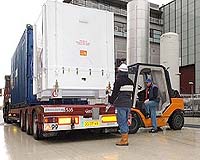
Baikonur, Kazakhstan (ESA) Dec 02, 2005 GIOVE A, the first Galileo satellite, departed from ESA's test facility at the European Space Research and Technology Centre in The Netherlands on the morning of 29 November, bound for the Baikonur Cosmodrome in Kazakhstan. The spacecraft, packed in its transport container and accompanied by its support equipment, was taken by road from the European Space Research and Technology Centre (ESTEC) to Amsterdam's Schiphol airport, where it was loaded onto an Antonov transport plane. GIOVE-A was flown first to Moscow and, after customs formalities had been completed, made the second leg of its air journey to Baikonur, arriving in the early hours of 30 November. It will be placed in orbit by a Soyuz/Fregat launch vehicle, with lift-off scheduled for late December. GIOVE A is the first of two Galileo In-Orbit Validation Elements, which with its sister spacecraft GIOVE B and their associated ground segment make up the first stage of the in-orbit validation (IOV) of the Galileo system. The main mission objectives of the GIOVE satellites are to: - Validate new technologies for operational use - Demonstrate the feasibility of broadcasting near-real-time orbit determination and time synchronisation data with high accuracy (uncertainty less than 50 cm), as envisaged for the full Galileo system - Secure the Galileo frequency filings - Characterise the radiation environment of medium earth orbit that the operational satellites will occupy GIOVE-A has been developed by Surrey Satellite Technology Ltd (UK). Galileo Industries (GaIn) is developing the GIOVE-B satellite. GaIn is a European consortium including Alcatel Alenia Space (F/I), Astrium (D/UK) and Galileo Sistemas y Servicios (E). GIOVE B is undergoing final integration and testing at the Rome facilities of Alcatel Alenia Space, prior to moving to the European Space Research and Technology Centre (ESTEC) for its environmental test campaign. It is due to be launched in 2006. Experience gained from the GIOVE missions will support the development of the Galileo IOV system. The next phase of Galileo IOV will be the deployment of the first four of 30 fully representative Galileo satellites that will be required for full system operation. Community Email This Article Comment On This Article Related Links SpaceDaily Search SpaceDaily Subscribe To SpaceDaily Express GPS Applications, Technology and Suppliers
 Galileo GIOVEA Using Marotta Equipment For Its Propulsion Systems
 Cheltenham, England (SPX) Jan 09, 2006
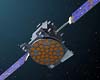
Marotta UK is pleased to announce that it designed, developed and qualified equipment for the cold gas propulsion systems on board the Galileo GIOVE-A, part of Europe's Galileo navigation program, successfully launched by Surrey Satellite Technology (SSTL). |
|
|

| The content herein, unless otherwise known to be public domain, are Copyright 1995-2006 - SpaceDaily.AFP and UPI Wire Stories are copyright Agence France-Presse and United Press International. ESA PortalReports are copyright European Space Agency. All NASA sourced material is public domain. Additionalcopyrights may apply in whole or part to other bona fide parties. Advertising does not imply endorsement,agreement or approval of any opinions, statements or information provided by SpaceDaily on any Web page published or hosted by SpaceDaily. Privacy Statement |