|
 |
 |
 |
 |
 |
 |
 |
 |

 |
First Flyby Of Dione
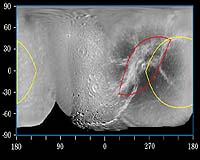
Pasadena CA (JPL) Dec 14, 2004 This map of Saturn's moon Dione, generated from Cassini images taken during the spacecraft's first two orbits of Saturn, illustrates the imaging coverage planned during Cassini's first Dione flyby on Dec. 14, 2004. Colored lines enclose regions that will be covered at different imaging scales as Cassini approaches Dione. Cassini will zoom past Dione at a distance of approximately 81,400 kilometers (50,600 miles) during this flyby. An even closer encounter with Dione is in store for Cassini in October 2005, when the spacecraft is slated to fly past the icy moon at a mere 500 kilometers (311 miles). Images from this week's flyby will be superior in resolution to those obtained by NASA's Voyager 1 in November 1980. Voyager 1 passed Dione at a distance of 161,520 kilometers (100,364 miles) at closest approach, yielding a best resolution of approximately 1 kilometer per pixel. The area to be imaged at highest resolution by Cassini during this upcoming flyby will be centered on the bright, wispy terrain on Dione's trailing hemisphere, marked by the red outline on this map. The resolution of Cassini images in this region will be 500 meters per pixel and better. The map was created by images acquired in visible light using the Cassini narrow angle camera. The highest southern latitudes on Dione have not yet been seen by Cassini, resulting in the map's lower limit of approximately 80 degrees south latitude. Community Email This Article Comment On This Article Related Links Cassini-Huygens at JPL Cassini Imaging Team SpaceDaily Search SpaceDaily Subscribe To SpaceDaily Express Explore The Ring World of Saturn and her moons Jupiter and its Moons The million outer planets of a star called Sol News Flash at Mercury
 Cassini Images Halo Around Titanic Moon Off Saturn
 Pasadena CA (SPX) Dec 27, 2005
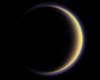
With its thick, distended atmosphere, Titan's orange globe shines softly, encircled by a thin halo of purple light-scattering haze. |
|
|

| The content herein, unless otherwise known to be public domain, are Copyright 1995-2006 - SpaceDaily.AFP and UPI Wire Stories are copyright Agence France-Presse and United Press International. ESA PortalReports are copyright European Space Agency. All NASA sourced material is public domain. Additionalcopyrights may apply in whole or part to other bona fide parties. Advertising does not imply endorsement,agreement or approval of any opinions, statements or information provided by SpaceDaily on any Web page published or hosted by SpaceDaily. Privacy Statement |