|
 |
 |
 |
 |
 |
 |
 |
 |

 |
First Evidence For Early Meteorite Bombardment Of Earth
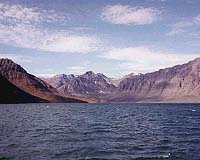
Brisbane - Jul 26, 2002 University of Queensland researchers have for the first time discovered terrestrial evidence of a meteorite bombardment nearly 4 billion years ago. It is widely accepted that the moon was heavily bombarded at this time, creating huge craters and basins. But although the effect of these impacts is still clearly visible on the moon today, movement of Earth's dynamic plates over geological time have reshaped the terrestrial surface dramatically, leaving little evidence of these catastrophic events. In a paper published in the international journal Nature, UQ researchers report evidence of the oldest impact events so far discovered on Earth. The research team of Dr Ronny Schoenberg, Dr Balz Kamber and Professor Ken Collerson of UQ's new Advanced Centre for Isotope Research Excellence (ACQUIRE) made the discovery by analysing 3. 8 billion year old rocks from West Greenland collected by Oxford University collaborator Professor Stephen Moorbath and from Northern Labrador in Canada collected by Professor Collerson. The researchers found these very old metamorphosed sedimentary rocks -- derived from the Earth's early crust -- contain anomalies in the isotope composition of the element tungsten. "Such anomalies are usually found in meteorites. To our knowledge, this is the first time these anomalies have been shown to exist in terrestrial samples" Professor Collerson said. "There is no plausible mechanism by which tungsten isotope anomalies could have been preserved in the Earth's dynamic crust-mantle environment. Therefore, we conclude these rocks must contain a compound derived from meteorites." "We have in effect found a chemical fingerprint in the earth's oldest terrestrial rocks of a heavy meteorite bombardment 3.8 to 4 billion years ago," he said. "This finding has implications for the origin of life on earth as these giant impacts would have annihilated any possible existing life forms but also delivered complex molecules from carbonaceous chondrites -- a type of meteorite -- to the earth's surface," Dr. Kamber added. "Further research on this unique collection of rocks will yield insight into the evolution of life on Earth provided provision of adequate research funding," Professor Collerson said. Community Email This Article Comment On This Article Related Links University of Queensland SpaceDaily Search SpaceDaily Subscribe To SpaceDaily Express Asteroid and Comet Impact Danger To Earth - News and Science
 NASA'S Deep Impact Tells A Tale Of The Comet
 Pasadena CA (SPX) Jul 11, 2005
Data from Deep Impact's instruments indicate an immense cloud of fine powdery material was released when the probe slammed into the nucleus of comet Tempel 1 at 6.3 miles per second. |
|
|

| The content herein, unless otherwise known to be public domain, are Copyright 1995-2006 - SpaceDaily.AFP and UPI Wire Stories are copyright Agence France-Presse and United Press International. ESA PortalReports are copyright European Space Agency. All NASA sourced material is public domain. Additionalcopyrights may apply in whole or part to other bona fide parties. Advertising does not imply endorsement,agreement or approval of any opinions, statements or information provided by SpaceDaily on any Web page published or hosted by SpaceDaily. Privacy Statement |